Three days after Thailand and Cambodia reached a new ceasefire agreement, Thailand has released 18 Cambodian soldiers captured since late July. Both countries hope the release of prisoners will foster mutual trust and peace.
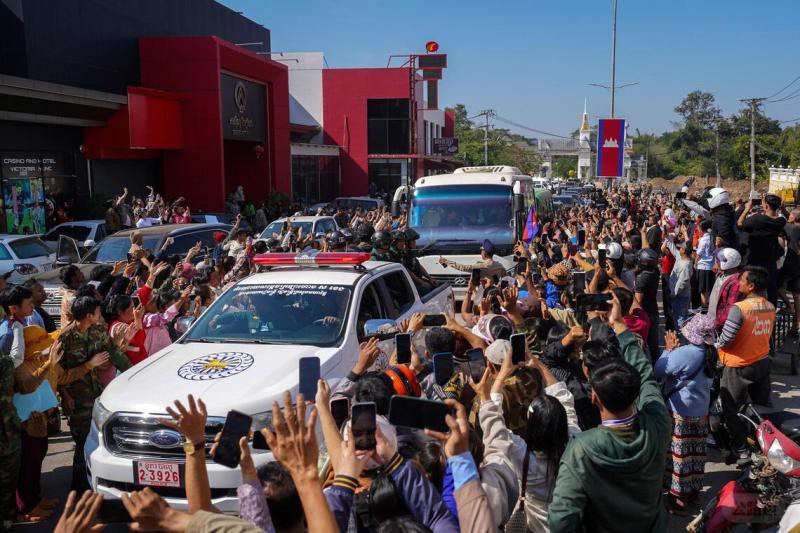
Cambodian Ministry of National Defence spokesperson Mari Serey Eddy confirmed that these soldiers, held in Thai custody for 155 days, safely returned home via a border crossing on Wednesday (December 31) at 10 a.m. local time (11 a.m. Singapore time).
Officials from the International Committee of the Red Cross (ICRC) and members of the ASEAN observer mission were present to witness the return of the Cambodian prisoners. Sok Lou, Governor of Cambodia’s Battambang Province, described the returning soldiers as “heroes.”
According to footage broadcast by Cambodia’s National Television, the 18 soldiers arrived by bus at the Pailin provincial border, where many locals gathered to welcome them with flowers.
Most of the Cambodian soldiers, sporting buzz cuts, smiled and waved or pressed their palms together in greeting to the crowd.
One freed soldier’s father, Vorn Vich, told AFP he would greet his son upon arrival in the capital Phnom Penh. “I’m so happy. I can’t wait to see him. I’ve missed him terribly.”
Cambodia issued a statement saying it hopes Thailand’s release of the prisoners will significantly enhance bilateral trust. “This will create a favorable environment for peace and stability between the two countries and lead to the full normalization of relations in the near future, benefiting the peoples of both nations.”
Thailand’s Ministry of Foreign Affairs also released a statement, saying Thailand had consistently treated the 18 Cambodian soldiers in accordance with international law and humanitarian principles. Prior to repatriation, they underwent medical check-ups and were fully informed of their rights to ensure their return was voluntary, safe, and dignified.
The statement added, “Thailand hopes Cambodia will reciprocate this goodwill through concrete actions to promote lasting peace between the two countries.”
ICRC President Mirjana Spoljaric, who oversaw the handover, said, “The release and repatriation of prisoners of war reunites families and marks an important step in turning the commitments outlined in the joint declaration into action.”
The prisoners were originally scheduled for release on Tuesday (December 30) at noon—72 hours after the ceasefire took effect—but Thailand delayed their release, accusing Cambodia of violating the agreement by launching approximately 250 drones and citing injuries sustained by Thai soldiers from landmines in border areas. Cambodia denied the accusations.
Although both sides have agreed to a ceasefire, the disputed border issue remains unresolved. On Monday (December 29), Cambodia announced it had invited Thailand to attend bilateral talks in early January 2026 in Cambodia “to discuss and continue surveying and demarcation work.”
Thailand responded on Tuesday, stating such work might need to wait until after its general election in February, when a new government takes office.
Thai Foreign Minister Sihasak Phuangketkeow said no definite schedule has yet been set for convening the Thai-Cambodian Joint Border Commission. “The current situation remains fragile,” he noted.
He added that any outcomes from the Cambodian side’s border commission discussions must first be submitted to Thailand’s Cabinet. As the current caretaker government is in power, any agreements reached would bind the incoming administration and thus require authorization from the existing government. Legal considerations will determine when and how the joint border commission meeting will be held.
Sihasak pointed out that one issue to be discussed within the border commission framework is establishing a direct hotline between the two countries to immediately verify incidents and prevent misunderstandings.
Regarding whether Cambodia’s alleged drone incursions into Thai airspace and the landmine injuries suffered by Thai soldiers might affect the ceasefire agreement, Sihasak responded that it must first be determined whether these landmines were newly planted or remnants from past conflicts.
He also stated that if the initial 72-hour ceasefire proceeds smoothly, the next phase will focus on building mutual trust, including preventing border provocations and clearing landmines.
Thailand and Cambodia reached a ceasefire agreement last Saturday (December 27) at noon, ending 20 days of conflict that resulted in at least 101 deaths and displaced over 500,000 people in each country.
|

 Fear of God ESSENTIALS Hoodie Review: Mi83 人气#fashion
 The Derby of San Francisco Style 300 Cha108 人气#fashion
 Why the Derby of San Francisco Classic S127 人气#fashion
 Romaoss Launches "Rebirth Plan," in Talk65 人气#tech



 WeChat
 douyin