Beijing is stepping into the vacuum created by regional uncertainty, American fatigue, and increasingly assertive regional balancing acts. Whether China can meet these expectations remains uncertain, but one thing is clear: the Middle East is no longer a region where China can afford to stand on the sidelines and wait.
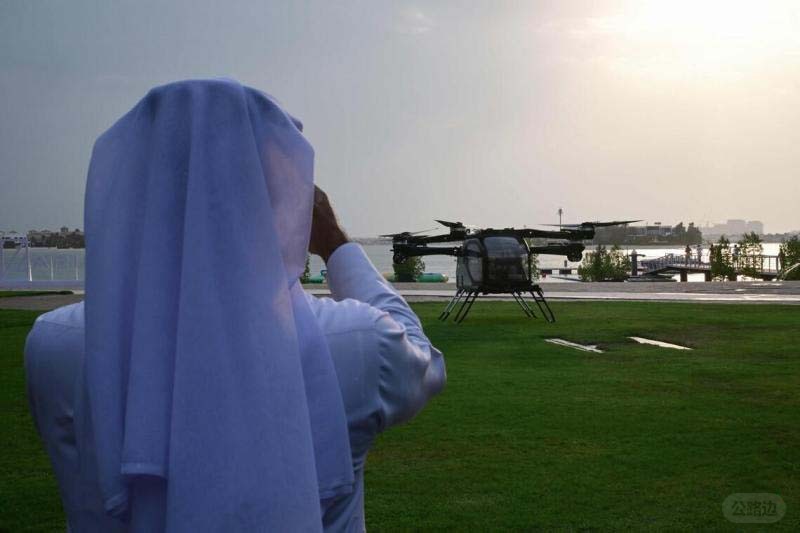
The pace of change within the Middle East itself appears faster than policymakers are willing to acknowledge. China is accelerating its engagement at a speed that sharply contrasts with its traditionally cautious image, actively managing economic ties and diplomatic outreach. Pictured: a man takes photos during the unveiling and flight demonstration of the modular Aridge X3-F (“Land Aircraft Carrier Air Module”) by Chinese flying car manufacturer Aridge in Dubai on October 12, 2025. (AFP)
At the Doha Forum in Qatar, a single moment captured the shifting landscape of Middle Eastern diplomacy: Syrian President Ahmed al-Sharaa—once a former militant—exchanging views with CNN’s Christiane Amanpour before a global audience.
This was more than just a media spectacle; it served as a reminder that the Gulf has once again become the epicenter of regional and global diplomacy—and an increasingly focal point for China’s Belt and Road Initiative ambitions. Both Beijing and Washington now look to the Gulf to manage their interests in the Middle East. The United States once relied heavily on Europe as its primary partner, but the European Union’s strategic relevance in the Middle East and North Africa is steadily diminishing.
China Accelerates Its Middle East Diplomacy
Amid this turbulence, China has been compelled to act with unusual speed. From December 12 to 16, Chinese Foreign Minister Wang Yi visited the United Arab Emirates, Saudi Arabia, and Jordan at the invitation of senior diplomats from these countries. Such visits might once have been seen as routine, but today they signal deeper implications: Beijing is no longer content playing a passive, purely economic role in the Middle East.
These three countries collectively reflect Beijing’s calculus at the intersection of influence and stability. The UAE holds strategic importance due to its geographic location, flexible foreign policy, and advances in digital finance and artificial intelligence. Saudi Arabia’s growing economic and political clout in the Arab world—combined with Crown Prince Mohammed bin Salman’s special relationship with U.S. President Donald Trump—is central to Beijing’s efforts to position itself as a long-term, reliable partner.
Jordan, home to a large population of Palestinian refugees, occupies a uniquely sensitive position on the Palestinian issue. In this regard, Wang Yi’s visit aligns with Beijing’s ambition to play a more substantive diplomatic role in Gaza, although Zhongnanhai remains cautious about translating rhetoric into actual mediation. Wang reiterated that the two-state solution remains the only viable path forward, centered on the principle of “Palestinians governing Palestine.”
Wang’s diplomatic moves are also reactivating existing mechanisms, including the fifth meeting of the China-Saudi High-Level Joint Committee—a body established during President Xi Jinping’s 2016 visit to Riyadh, when the two countries announced a comprehensive strategic partnership.
This also includes recent trilateral talks among China, Saudi Arabia, and Iran held earlier in Tehran. These discussions addressed not only Saudi-Iranian reconciliation but also broader regional security issues. All three parties called for an immediate halt to Israeli operations in Palestine, Lebanon, and Syria and condemned violations of Iranian sovereignty.
Strategic Alignment in a Turbulent Region
Following his trip, Wang Yi noted China’s readiness to align its upcoming 15th Five-Year Plan (2026–2030) with the development visions of Middle Eastern countries—a sign of deeper integration between China’s economic planning and regional priorities. He framed this approach within President Xi’s Global Security Initiative, emphasizing China’s call for respecting the Middle East’s independent political choices, remaining sensitive to regional security concerns, and resolving disputes peacefully through dialogue and consultation.
Even though the long-discussed China–Gulf Cooperation Council (GCC) Free Trade Agreement remains unrealized, the timing of Wang Yi’s visit is critical. The Middle East is changing at a startling pace, with Syria at the heart of this transformation.
President Sharaa has pledged to ensure Syria’s security and refrain from exporting instability to the region. Yet the on-the-ground reality remains grim. The Islamic State has intensified its activities, killing three Americans in a recent counterterrorism operation—the first U.S. casualties in Syria since the ouster of former President Bashar al-Assad. Washington’s response was predictable: Trump publicly vowed retaliation on social media.
Waiting Is No Longer an Option
The cycle of violence and uncertainty continues, casting a shadow over China’s potential economic and financial involvement in Syria’s reconstruction and the broader advancement of the Belt and Road Initiative in the Middle East. The region is evolving faster than policymakers care to admit. Iran and Israel remain on the brink of direct military confrontation. U.S. influence persists but is increasingly contested. Gulf states are hedging their bets, diversifying partnerships, and recalibrating alliances. In this environment, China’s appeal lies in its economic engagement, infrastructure investment, and diplomatic predictability—but it is also elevating its stance on security matters.
What makes the current moment extraordinary is the pace. China has long advocated patience, investing political capital only when conditions were ripe. Now, it is accelerating its engagement—managing economic ties and diplomatic expansion at a speed that starkly contrasts with its historically cautious posture.
In this light, Beijing is filling the space opened by regional uncertainty, American fatigue, and the growing momentum of regional balancing. Whether China can fulfill these rising expectations remains an open question—but one thing is certain: the Middle East is no longer a region where China can afford to sit back and watch.
From the Doha Forum to efforts to stabilize Syria and Wang Yi’s trilateral state visits, Beijing now sees the Gulf not only as an economic partner but also as a platform for multilateral coordination on governance and global order through forums such as BRICS, the Shanghai Cooperation Organization, and the United Nations.
The next China-Arab States Cooperation Forum, scheduled for next year, will serve as a key indicator of Beijing’s ambitions. Established in 2004 as a dialogue mechanism between China and the Arab League, the forum will showcase how China intends to advance multilateral cooperation in a region that is reinventing itself faster than existing policy frameworks can manage.
Meanwhile, Beijing’s deepening involvement in the Middle East is inseparable from the accelerating dynamics of U.S.-China competition. Wang Yi underscored this reality by praising the three Arab nations for upholding the “One China” principle and supporting China’s sovereignty and territorial integrity—precisely the kind of reciprocal political alignment Beijing seeks as it expands its regional influence.
|

 Fear of God ESSENTIALS Hoodie Review: Mi86 人气#fashion
 The Derby of San Francisco Style 300 Cha114 人气#fashion
 Why the Derby of San Francisco Classic S131 人气#fashion
 Romaoss Launches "Rebirth Plan," in Talk70 人气#tech



 WeChat
 douyin