Recently, I spoke with several professionals in the food and beverage industry about the booming private-label business. I initially assumed that some contract manufacturers—freed from the “middleman” of big-name fast-moving consumer goods (FMCG) brands by supplying private-label products to major retailers—were finally singing songs of liberation like emancipated serfs. But surprisingly, more and more established FMCG brands are now joining this trend, and their direction seems increasingly skewed.
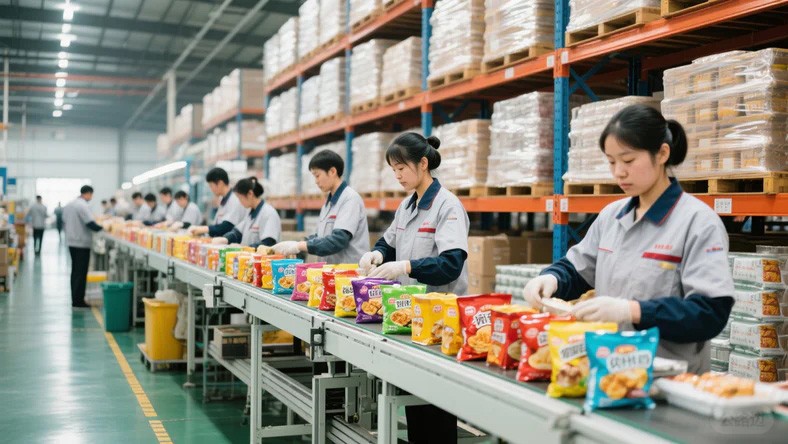
“Our company’s strategy this year is ‘no new sales hires—only exits’—but we’ve massively increased headcount in R&D and production,” said Lao Cao, a regional manager in South China for a certain company. His sales team is severely understaffed, yet every request to refill vacant positions has been denied after employees leave. Roles are being downgraded, and according to headquarters, most new hires this year are going to the contract manufacturing division.
“Our company is even worse,” said another channel manager at a food company. “Some aggressive insiders have even advised the CEO to abandon traditional channels altogether and focus solely on contract manufacturing.” Regarding today’s private-label boom, he added, “The original intent was just to keep production lines running—but now contract-manufactured products are actively cannibalizing our own branded products.”
The Shift in Consumer Behavior
The move from branded to private-label goods reflects a fundamental shift—from brand-driven to channel-driven sales. In recent years, consumers have transitioned from trusting brands to trusting retail channels.
In the past, when purchasing a product, consumers first considered the brand, then taste, and finally price. Whether shopping at hypermarkets or neighborhood mom-and-pop stores—from tier-one cities to rural towns—consumers trusted household names like Coca-Cola, Master Kong (Kangshifu), Uni-President, and Nongfu Spring. They knew these brands guaranteed quality, and if counterfeit goods appeared, the manufacturers themselves would handle it. That’s why fake products like “Six Nuclear Bombs” or “Lebi” (knockoff Pepsi) could still deceive people—they exploited that deep-seated brand trust.
But as brands became increasingly homogenized and indistinguishable, consumers shifted toward channel trust. For many, Sam’s Club represents bulk value and fair pricing—it earns only from membership fees, not product markups. Products there are exclusive, unavailable elsewhere, and carry a subtle sense of middle-class pride. Similarly, at Pang Donglai or its “Pang-reformed” stores, consumers believe they’re getting Pang Donglai’s quality assurance—viewing it as an ethical enterprise that truly understands shoppers. This is the “channel halo effect.”
Take a simple example: if your iPhone has an issue, people often ask, “Where did you buy it?”—implying the problem might stem from the purchase channel, not Apple itself. Likewise, despite rampant chaos in live-streaming commerce, consumers still willingly buy unbranded products promoted by certain hosts—precisely because they trust the host as a credible “channel.”
This behavioral shift presents opportunities for contract manufacturers, counterfeit producers, and even established brands. Contract and knockoff factories no longer need to pay the “brand tax”; they can supply channels directly. Historically, these factories lacked the “credibility capital” to get shelf space in major retailers like Carrefour—consumers didn’t trust them, so even if they paid for placement, they’d often end up delisted quietly. But supplying Sam’s Club or Freshippo (Hema) solves that: the retailer’s strict curation acts as a quality stamp. If you’re in, your product has merit—you don’t need a brand, a sales force, or marketing; just run your factory.
For big-name FMCG companies, contract manufacturing offers incremental volume—activating idle production lines, smoothing out seasonal dips, and lowering operational costs. Crucially, private-label business is driven entirely by retailer demand, bypassing internal corporate constraints.
Traditional FMCG companies often fail with every new product launch—not just due to poor R&D, but because their own employees and distributors resist pushing novelties, deeply skeptical of anything new. Over time, large FMCG teams grow misaligned: leadership sets aggressive targets, but local teams game the system—“I’ll hold back this year to protect my position, push hard next year,” or “I’ll prioritize Market A but neglect Market B.” The result? Corporate directives never leave headquarters.
In contrast, private-label projects flip this dynamic. Sam’s Club demands constant innovation: “Bring all your new products to me—I’ll sell them.” If your product sells well, scale up production immediately—no artificial quotas, just pure consumer demand. Many of Pang Donglai’s best-selling private-label items were originally underperforming branded products. For instance, its laundry detergent—contract-manufactured by Liby without optical brighteners—would have been criticized if sold under Liby’s own brand (“doesn’t whiten clothes!”). But under Pang Donglai, if clothes don’t look white, consumers blame the fabric, not the detergent. Similarly, Pang Donglai’s “DL Water,” made by Uni-President, now outsells Uni-President’s own “Aqua” brand.
Private-Label Mania Gone Too Far
Yet ideals are lush, reality is lean. Many big manufacturers have become obsessed—almost delusional—about private-label business.
Sam’s Club demands continuous innovation, but with a catch: once you develop a new product for them, your own brand cannot sell it. Worse, Sam’s often requires you to hand over your proprietary formula—then turns around and gives it to cheaper contract manufacturers to produce.
Major FMCG players invest heavily in R&D, operations, and production—despite their bureaucratic inefficiencies. Now, lured by Sam’s short-term gains, they surrender their core formulas and technical know-how. Yes, FMCG may have low barriers to entry—but even so, Master Kong’s Braised Beef Noodles remain unmatched, and Red Bull’s flavor is something even War Horse can’t replicate. These subtle differentiators are the lifeblood of any brand. Yet with a single request from Sam’s, companies hand over years of R&D investment without hesitation.
This essentially erodes the technological edge of major brands—turning “Lebi” into “Sprite,” and “Wangzai Drink” into “Want Want Milk.” Previously, small players who acquired such technology upgraded their capabilities. Thanks to their agility, they reinvested profits into better production lines—and now compete directly for the very private-label contracts once dominated by big brands.
Sam’s Club also squeezes suppliers relentlessly, demanding endless innovation while brands exhaust their R&D teams to maintain the partnership. An imperfect analogy: big FMCG firms have become Sam’s “wombs”—constantly “giving birth,” only for Sam’s to take the “child” and hand it to others to raise. Some contract manufacturing heads, chasing performance metrics, now block new products from testing in traditional channels—prioritizing Sam’s orders above all.
Even worse, contract divisions within FMCG companies are now directly competing with their own branded businesses. For example, a certain brand’s Product A was selling well at Aldi. Then the company’s contract manufacturing team approached Aldi’s procurement: “We can make a similar product to A, but at a lower price—and under your Aldi brand.” Naturally, Aldi switched suppliers, kicking out the original branded product. What began as an effort to generate incremental volume through contract manufacturing has turned into self-cannibalization—overall sales and profits are now declining.
As for the goal of “activating idle production lines”—consider the geographic reality. Sam’s, Freshippo, and Pang Donglai stores are concentrated in specific regions. Trying to utilize idle capacity in Northwest or Northeast China would incur sky-high logistics costs. In practice, companies end up diverting already busy production lines in East, Central, and South China—delaying shipments of their own branded goods to prioritize private-label orders and protect retailer relationships.
The root cause of this self-sabotage lies in flawed KPI systems. Ideally, contract manufacturing divisions should be evaluated on profitability—but many companies now measure them solely by revenue growth. To hit those targets, contract units inevitably steal volume from their own branded products.
The bad news? Sam’s Club is currently mired in scandals. Beyond the recent “mochi mouse incident,” it recently hired Alibaba executives to oversee product selection—a move that’s eroding consumer trust in its channel integrity. When you hand your fate over to a retailer, you’re sacrificing long-term survival for short-term gain.
|
 Fear of God ESSENTIALS Hoodie Review: Mi86 人气#fashion
 The Derby of San Francisco Style 300 Cha113 人气#fashion
 Why the Derby of San Francisco Classic S130 人气#fashion
 Romaoss Launches "Rebirth Plan," in Talk70 人气#tech



 WeChat
 douyin