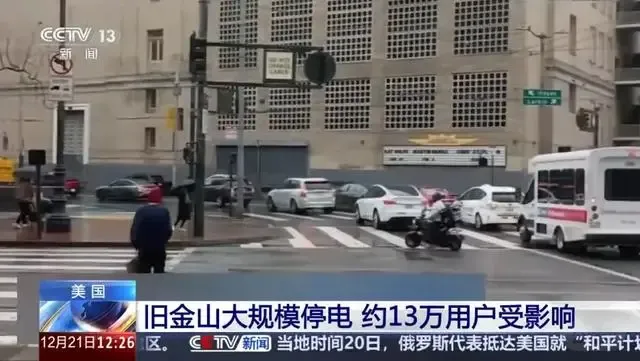
A major power outage struck San Francisco on December 20, plunging approximately 130,000 customers into darkness. As of the morning of December 21, more than 20,000 users remained without electricity, according to Pacific Gas and Electric Company (PG&E).
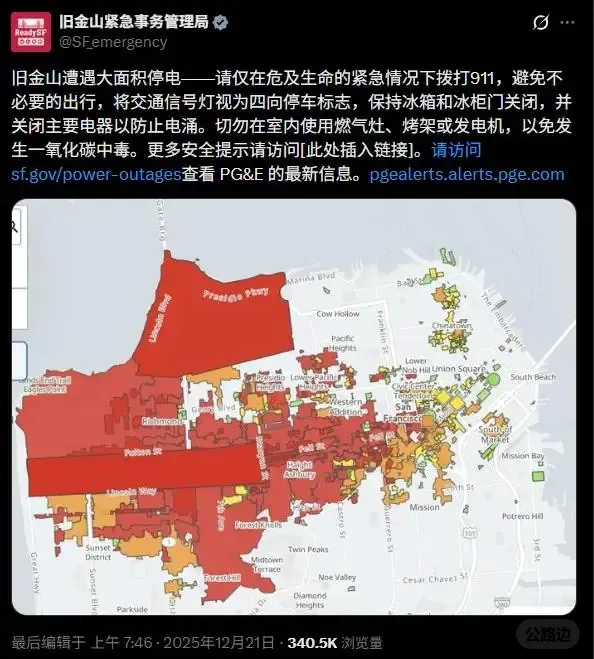
The first blackout hit around 9:40 a.m. local time, cutting power to roughly 15,000 homes and businesses. A second wave followed at 10:10 a.m., affecting an additional 25,000 customers, per PG&E’s live outage map. By 5:30 p.m. that day, the utility still couldn’t provide any estimated restoration times for affected neighborhoods—a critical blow during the peak holiday shopping and social season, forcing countless stores to shutter.
San Francisco activated its Emergency Operations Center that afternoon to coordinate citywide response efforts. While the exact cause of most outages remains under investigation, the San Francisco Fire Department confirmed that a fire broke out at a PG&E substation that afternoon, triggering partial blackouts across the city.

The cascading effects quickly spilled onto the streets: traffic signals went dark en masse, snarling intersections—and critically disrupting Waymo’s autonomous ride-hail service. Multiple driverless vehicles were left stranded mid-route, grinding to a halt and contributing to widespread gridlock.
On the afternoon of December 21, Waymo issued a statement confirming its service had been suspended due to the blackout and was now resuming operations. “We’re restoring ride-hail service across the Bay Area,” a company spokesperson said. “Yesterday’s widespread outage caused severe traffic congestion in San Francisco, knocked out traffic signals, and disrupted public transit.”
The company emphasized it is working closely with city officials to “rapidly incorporate lessons learned” from the incident.
Waymo, a subsidiary of Alphabet (Google’s parent company), has operated fully driverless commercial taxi services in San Francisco since August 10, 2023, when the California Public Utilities Commission (CPUC) approved its 24/7 permit by a 3–1 vote. The service has now run for over two years.
Earlier this year, on November 3, Waymo announced plans to expand its robotaxi network to Las Vegas, San Diego, and Detroit in 2025. It currently operates in five U.S. cities, including Los Angeles, Phoenix, and Austin.
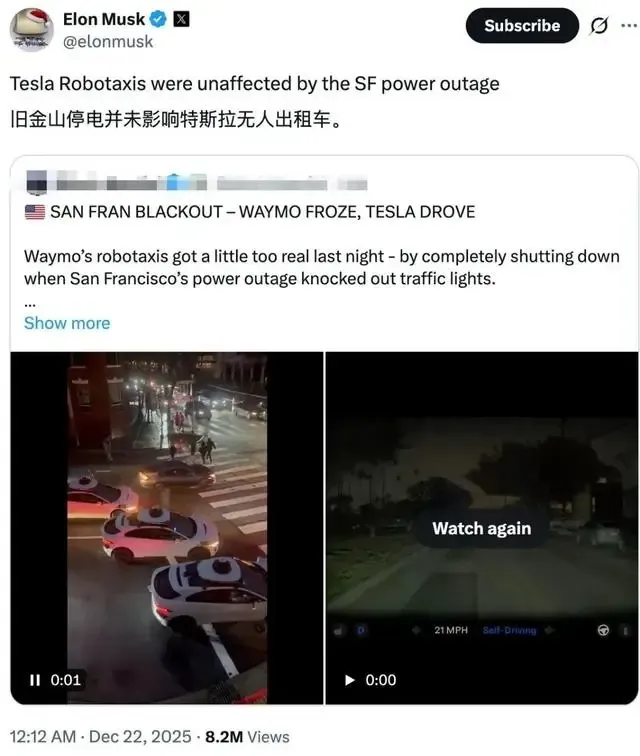
Notably, the outage did not impact Waymo’s rival Tesla.
Tesla CEO Elon Musk posted on X: “Tesla Robotaxi was unaffected by the San Francisco power outage.”
That said, unlike Waymo, Tesla does not yet hold a California permit for fully driverless testing or commercial operation. All its vehicles must carry a human safety operator ready to take control at any moment.
Dr. Brian Limer, a scientist at MIT’s Mobility Systems Center, called the incident a wake-up call: “Waymo’s service suspension in San Francisco reveals critical oversights in the design and deployment of autonomous systems.”
“Cities simply aren’t ready for large-scale integration of highly automated vehicles,” he added. “For the foreseeable future, we’ll still need to blend human intelligence with machine intelligence—and maintain human backup mechanisms alongside advanced systems like robotaxis.”
|

 Fear of God ESSENTIALS Hoodie Review: Mi86 人气#fashion
 The Derby of San Francisco Style 300 Cha112 人气#fashion
 Why the Derby of San Francisco Classic S130 人气#fashion
 Romaoss Launches "Rebirth Plan," in Talk70 人气#tech



 WeChat
 douyin