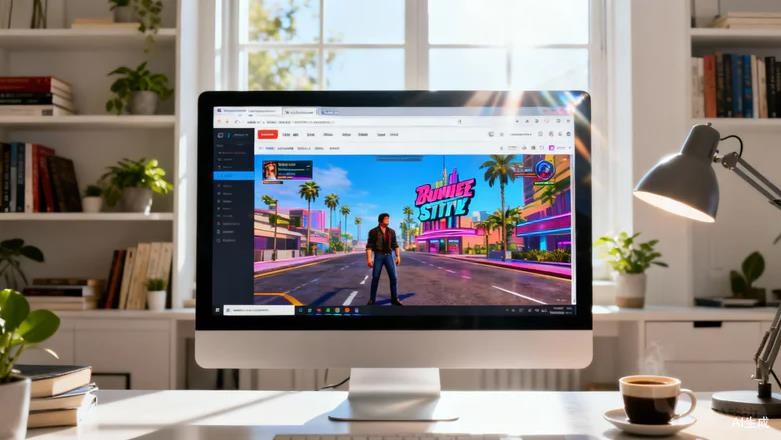
Have you guys seen the “browser-based GTA: Vice City” lately?
I’ve been bombarded with it on foreign websites these past few days.
It all started when a blogger named beebom tweeted that you can play GTA: Vice City right in your browser.
The tweet went viral instantly, racking up 1.8 million views and over 20,000 saves from netizens.
Reddit users wasted no time sharing the news, with several popular posts getting thousands of upvotes.
According to TheGamer, the browser version of GTA: Vice City was launched over 300,000 times on its first day online.
I jumped on the bandwagon right away too.
To be honest, when that familiar opening animation popped up in my browser, my DNA reacted instantly—I can still recite a few lines of the dialogue by heart.
Once you officially enter the game, you’ll find it’s the same old formula, the same classic vibe: speeding recklessly down the street, picking a random stranger to punch, spotting a luxury car and “borrowing” it (you know the drill with the F keys)...
The entire experience was smooth, with no loading issues at all.
The coolest part? This browser version even supports cheat codes.
I typed in that most iconic secret code—Panzer—and then that tank without side mirrors dropped out of nowhere onto the asphalt road...
In that moment, I felt like I was back in a smoky internet café over a decade ago: a bulky CRT monitor in front of me, a 50-cent bag of crispy noodles by my side, and a pair of cheap headphones that randomly deafened one ear.
However, due to copyright issues, this browser version of GTA: Vice City has some limitations.
You can only play the demo—all normal functions are available, but you can’t progress the storyline. To unlock the full version, you need to upload your own legitimate game files, and the website uses SHA-256 to verify if you’re a genuine player.
In fact, the website had no choice but to do this.
Rockstar Games is notoriously zero-tolerant of fan-made ports and secondary development. Once they target you, it’s a cease-and-desist letter—no exceptions.
Even though the browser version only lets you wander around the city, I don’t think it matters much.
Who actually did the missions properly when playing GTA: Vice City as a kid? We all typed in cheat codes at the start, summoned a tank, then sprayed bullets all over the street to see how long we could last before getting taken down by the cops...
Failed to become a five-star good citizen!
If you think this is just a browser version of GTA: Vice City, then I’m afraid you’re thinking too small.
When I clicked into the game’s homepage, I realized this website called DosZone is actually a museum of classic games.
The site has ported over 2,000 classic games—everything from the 1980s to the early 2000s that defined our childhoods: 3D Pinball, Road Rash, DOOM, Need for Speed...
The experience is 100% authentic, and it even supports local browser save files—save now, continue playing later...
Let’s fire up Road Rash and beat up some opponents!
Then play Need for Speed and take that drain turn like a pro!
I won’t test every game one by one, but I can say this website (https://dos.zone/) is a lifesaver for Gen X and millennials.
After all, when many people want to revisit childhood games, they’re always frustrated by various environment configurations and compatibility issues. Now?
Just open your browser and play.
Even if you don’t have a computer nearby, DosZone has a dedicated mobile section, letting you enjoy games directly on your phone or tablet...
Speaking of which, some of you might be curious: how did these decades-old games get squeezed into a browser?
I did some research, and DosZone mainly uses two methods.
First: emulator nesting.
Tools like DOSBox already exist on GitHub, which can simulate full DOS or Windows 95/98 environments. What the DosZone team did was use a technology called WebAssembly to embed these emulators into the browser.
But just having the environment isn’t enough. Browsers speak JavaScript, while old games use DOS commands—they don’t understand each other. So the team developed js-dos, which acts like a simultaneous interpreter for old games, allowing them to communicate seamlessly with modern browsers.
With the environment and interpreter in place, old games can run smoothly in the browser.
The second method is more hardcore: reverse engineering and remaking—
Instead of using the original code, they write an entirely new set of code with identical functionality.
For example, the browser version of GTA: Vice City relies on a legendary project called reVC.
A group of tech experts disassembled the original GTA: Vice City code, spent 7 months rewriting it in modern programming languages, and created a version with exactly the same features as the original—only with new code (similar to the browser-based Command & Conquer Red Alert from a while back).
Although the official reVC GitHub repository was taken down a few years ago (thanks to Rockstar), backups exist on the Internet Archive and other GitHub forks. That’s why the DosZone team was able to compile reVC into a WebAssembly version, then redesign underlying systems like rendering, input, audio, and file reading to make it run smoothly in the browser.
In short, using emulators and reverse engineering/remaking, DosZone ported games to the web bit by bit. Just thinking about the workload makes my head spin—especially since many games also need to be adapted for mobile controls.
Now for the key question: is this website paid, or does it have ads?
I double-checked: all games are free to play, with no ads whatsoever.
This is the DosZone team’s official statement—the project is completely free, non-commercial, and they do not gain any benefits or profits from it.
Are they serious? Total saints?
I did a quick background check on the team.
Turns out the DosZone team is a group of Russian tech enthusiasts who came together out of a shared love for classic games and modern technology.
Founder Alexander Guryanov is the soul of the project—he single-handedly created js-dos and dos.zone.
Besides tech experts, the team includes people dedicated to game porting, promotion and resource organization, front-end development, operations, translation, and community management.
Yep, a full team with clear roles—just no salaries...
After all, this whole thing exists in a bit of a legal gray area, and the team has been very restrained: they only use open-source and abandoned software, publish code under the GPL license, and immediately take down content if they receive a notice from copyright holders—never fighting back.
Their only income comes from voluntary user donations and subscription fees for cloud save storage.
To be honest, in an era where you have to watch 30 seconds of ads to see a 10-second video, and even after buying a membership you need to upgrade to a “super membership,” what these guys have built is truly rare—it reminds me of the early days of the internet.
No business model, no desire for money or fame—just pure passion for doing something cool: letting those nearly forgotten old games be played by more people.
P.S.: Right after writing the last sentence of this article, I found out the browser-based GTA: Vice City has been taken down following a warning from Take-Two and Rockstar.
Damn it—they spend ten years polishing a game, but send out cease-and-desist letters in the blink of an eye.
|

 Fear of God ESSENTIALS Hoodie Review: Mi86 人气#fashion
 The Derby of San Francisco Style 300 Cha112 人气#fashion
 Why the Derby of San Francisco Classic S130 人气#fashion
 Romaoss Launches "Rebirth Plan," in Talk70 人气#tech



 WeChat
 douyin