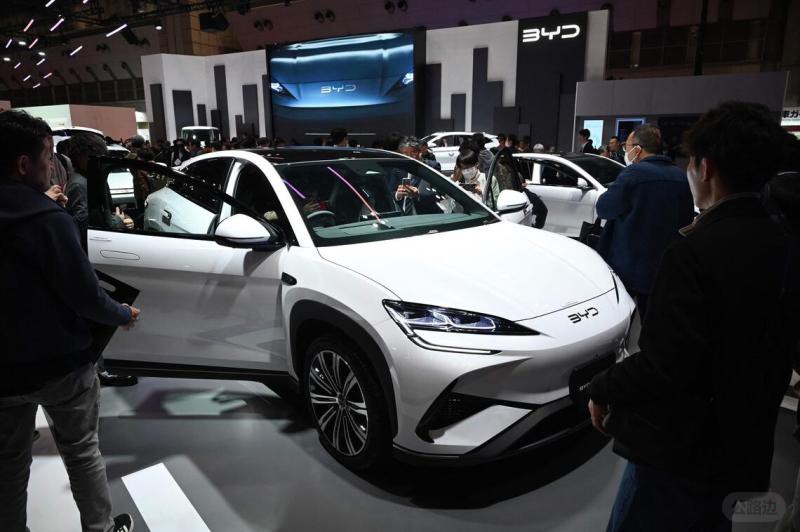
Analysts believe that against the backdrop of sluggish economic growth and policy uncertainties, the downward trend of China’s consumer stocks will persist. The picture shows people visiting BYD’s Chinese electric vehicles displayed at the Japan Mobility Show held in Tokyo at the end of October this year. (AFP)
China’s consumer stocks have been on a continuous decline and are expected to notch the longest annual underperformance record in history. Analysts predict that this downward momentum will continue amid tepid economic growth and policy uncertainties.
According to Bloomberg reports, the CSI 300 Consumer Staples Index, which tracks the performance of essential consumer goods stocks listed in mainland China, is projected to underperform the broader CSI 300 Index for the third consecutive year. UBS Group and Everbright Securities International pointed out that the weakest retail sales performance since the COVID-19 pandemic, coupled with the prolonged slump in housing prices, may continue to dampen household consumption expenditure.
Peng Yanyan, Head of Greater China Consumer Sector Research at UBS, expects overall consumption to remain sluggish, with retail sales growth potentially dropping even further below this year’s levels.
In recent years, China has been grappling with deflationary pressures, where sluggish price increases have eroded corporate profits and household incomes. Although boosting domestic demand was listed as a top priority at two key policy meetings this year, the consumer sector index still fell by 6.6% in 2025, while the CSI 300 Index rose by 16% over the same period.
Wu Lixian, Strategist at Everbright Securities, said, “Given the weak performance in the fourth quarter, the outlook for an economic rebound next year remains uncertain. Despite continued policy support for traditional consumption sectors, the marginal effects have been waning.”
On a granular level, pressures vary across sub-sectors within the consumer segment. Baijiu stocks were once darlings of China’s investment community, but they have emerged as a major drag on the index amid Beijing’s drive to curb excessive spending and clamp down on official banquet scandals. Kweichow Moutai and Wuliangye, the two largest-weighted stocks in the index, have fallen by 7.5% and 21% respectively so far this year.
Home appliance and automobile manufacturers previously benefited from trade-in programs, but their performance this year has lagged significantly behind that of last year. The $41 billion (S$52.9 billion) stimulus package launched last year released pent-up demand, but over time, the policy effects have gradually faded. Among leading enterprises, Midea Group has risen by 5.6% year-to-date, while BYD has remained flat, compared with respective gains of 38% and 43% in the same period last year.
However, the market is not entirely devoid of bright spots. Peng Yanyan opines that the market may still stage a rebound if the government introduces or adjusts consumption stimulus policies. In addition, emerging categories such as trendy toys, chain tea beverages, high-end jewelry, and pet supplies have registered robust growth in recent years, warranting sustained attention.
Most views also hold that it will take time for the market to recover. Bloomberg noted that so far, the 12-month forward earnings-per-share (EPS) estimates for the CSI 300 Consumer Staples Index have been revised down by more than 7%.
Data released by the National Bureau of Statistics of China last week showed that retail sales of consumer goods, a key indicator for measuring consumption, slowed sharply to 1.3% year-on-year in November from 2.9% in October, marking the lowest growth rate since the lifting of zero-COVID restrictions in December 2022.
In response to the persistent weakness in domestic consumption, senior officials of the Communist Party of China emphasized at the Central Economic Work Conference held this month that the country will maintain appropriate fiscal deficits, total debt levels, and expenditure intensity next year. This will provide support for further stimulating domestic consumption and investment, as well as stabilizing the driving forces of economic growth.
|

 Fear of God ESSENTIALS Hoodie Review: Mi86 人气#fashion
 The Derby of San Francisco Style 300 Cha113 人气#fashion
 Why the Derby of San Francisco Classic S131 人气#fashion
 Romaoss Launches "Rebirth Plan," in Talk70 人气#tech



 WeChat
 douyin