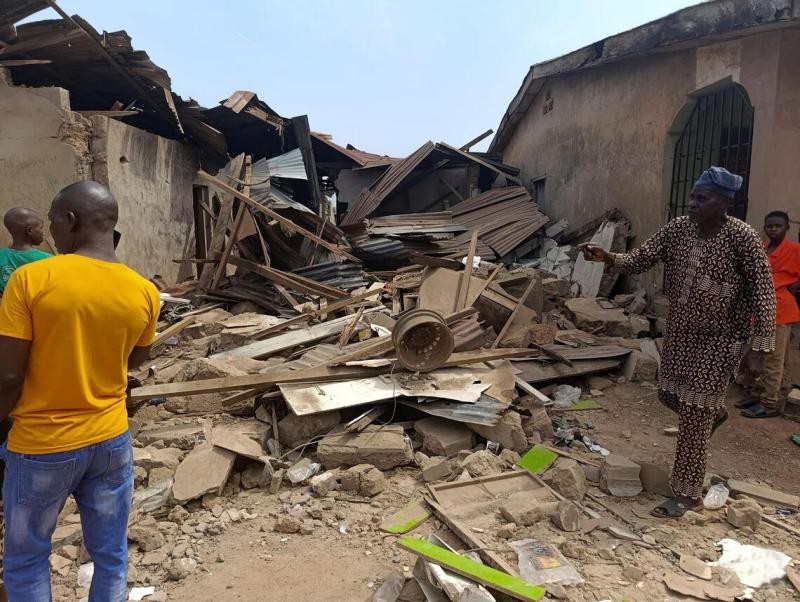
On Christmas Day, U.S. military forces launched missile strikes against targets affiliated with the Islamic State (IS) in Nigeria. The targeted sites included the town of Offa in Kwara State, western Nigeria, according to Reuters.
Military experts have criticized the decision as unwise and politically driven, arguing that it squanders military resources on issues unrelated to core U.S. interests. Reports also indicate that one village hit by the U.S. military was not an area where terrorists were active.
On Thursday, December 25, Trump announced on social media that U.S. forces had “carried out a strong and lethal attack against Islamic State terrorists in northwestern Nigeria—these bastards have been targeting and murdering innocent Christians there”.
The Nikkei reported on Saturday, December 27, that the operation had sparked widespread criticism in the United States, raising two key questions. First, it was unwise for the U.S. military to use long-range missiles, which are in short supply, for the attack. Second, the operation had no bearing on core U.S. interests.
Thomas Karako, Director of the Missile Defense Project at the Center for Strategic and International Studies (CSIS), a U.S. think tank, stated that the United States should exercise caution in deploying long-range and standoff weapons to reserve them for potential conflicts with China. “We have thousands of long-range missiles, but that does not mean we have enough. If we do go to war with China, we might need to launch thousands of these missiles”.
Karako noted that U.S. operations in Syria, Yemen, and Iran had already consumed a significant number of Tomahawk missiles. “Why not use gravity bombs when attacking a target with no anti-missile systems?”.
Neither Trump nor U.S. Africa Command (AFRICOM) disclosed the type or quantity of missiles used in the strike. However, a video released by the Pentagon showed a missile launched from a Mark 41 Vertical Launch System, which is designed for firing long-range missiles.
Kelly Grieco, a Senior Fellow at the Stimson Center, argued that while such long-range counterterrorism strategies could be justified under strategic restraint if terrorists’ international expansion threatened U.S. interests, she did not believe the situation in Nigeria affected U.S. interests.
Grieco suggested that Trump’s decision was more likely politically motivated to cater to the demands of some of his supporters. “Choosing to act on a major Christian holiday was clearly no coincidence”.
Jennifer Kavanagh, a scholar at Defense Priorities, a Washington-based think tank advocating for diplomatic and strategic restraint, went further, describing Trump’s decision as “unnecessary and unreasonable.” She argued that it violated his commitment to prioritize U.S. interests and avoid dangerous, resource-intensive military entanglements overseas.
The 2025 National Security Strategy released by the Trump administration earlier this month made only a brief mention of Islamic terrorist activities in Africa on its final page, emphasizing that the United States should avoid long-term involvement in local affairs.
The Village Hit by U.S. Forces Was Not a Hotbed of Terrorist Activity
Acting at the request of the Nigerian government, U.S. forces launched missile strikes against local IS targets. One missile landed in the village of Jabo in Sokoto State, northwestern Nigeria, less than 500 meters from a medical center, triggering panic among local residents.
CNN reported on Saturday, citing local sources, that while parts of Sokoto State have been plagued by armed robberies, kidnappings, and attacks—including by groups officially linked to the Islamic State—Jabo itself is not an area rife with terrorist activity, and local Christians and Muslims coexist peacefully.
Analysts point out that Nigeria’s long-standing unrest stems from multiple factors, including ethnic conflicts and clashes of interests between farmers and herders, and is not a purely religious issue. While U.S. military action may have eliminated some militants, it is unlikely to put an end to the multi-faceted violence that has erupted in various regions due to long-term government governance failures.
|






 2
2 0
0