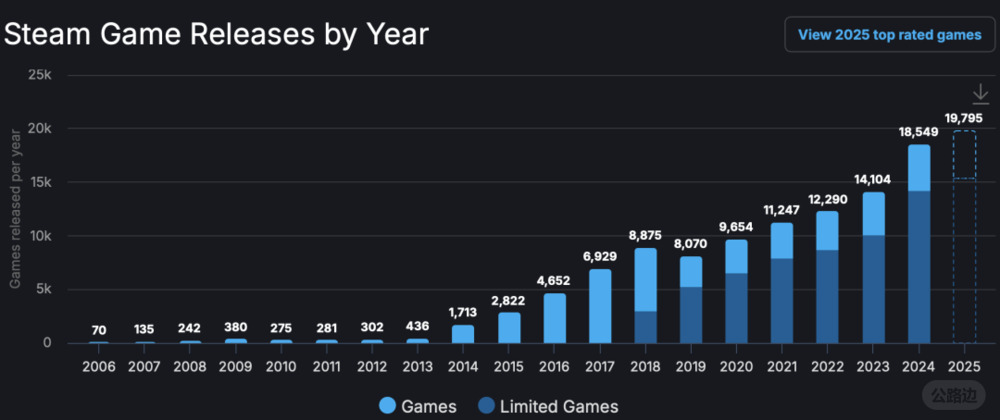
According to SteamDB data, nearly 20,000 new games were released on Steam in 2025 alone. This figure—representing the primary platform for small and mid-sized studios—seems to signal a thriving indie game market.
Even focusing solely on domestic Chinese indie games, the numbers have surged over the past decade. According to the Chinese Game Sales Chart, more than 1,600 Chinese-developed games launched on Steam in 2024—a 45% year-over-year increase.
Yet behind these figures lies a paradox: while the ecosystem has matured significantly, developers aren’t necessarily faring better. Platforms, publishers, investors, expos, and competitions are now abundant—but Snake, founder of “Indie Light,” shared a sobering statistic: the median revenue for Chinese indie games on Steam is just over $1,000. “A five-person team might earn less from a game than they would selling snacks at a public square.”
This coexistence of maturity and hardship may be the most honest summary of the past ten years of indie game development.
01
Changes in Platforms and Distribution Channels
In the early days, the indie game market was a lawless frontier awaiting rules and structure—few practitioners, scarce channels, rampant piracy.
In 2010, Ye Qianluo, founder of indie publisher Gamera (later renamed Gamirror), was still working in game media. Back then, the term “indie game” had no clear definition; similar titles were often called “doujin games” and sold sporadically via physical discs on Taobao or personal websites, with unstable sales.
At the same time, seeds of the indie scene were already sprouting. In 2010, industry veteran Peng Bitao founded the “Indie Planet” community, gathering a group of early enthusiasts. Though small, this circle quietly played and discussed obscure titles. Yet their passion hadn’t broken out of its niche—the scene was still far from becoming a true industry force.
A bigger issue was the lack of connection among developers. Scattered across Beijing, Shanghai, Guangzhou, Chengdu, and elsewhere, indie creators worked in isolation, unaware of each other’s existence. There were no communication channels or showcase platforms. Even IGF China (the Chinese arm of the Independent Games Festival) mostly featured overseas entries—local voices drowned out by international competition.
Meanwhile, the mobile gaming market was in its wild west phase. Jason, founder of Veewo Games, recalls that in 2011, he and two non-gaming-background partners started a studio on Zhichun Road in Beijing. The barrier to entry was extremely low: “You didn’t need to know game design, and funding was easy to get.”
Distribution channels held overwhelming power. The revenue split between content providers (CPs) and app stores sometimes reached 1:9—if a channel promoted something, users played it. The smartphone boom made “reskinned” mobile games (titles with identical mechanics but different art) seem profitable with minimal investment.
Veewo wasn’t immune. In 2014, they cloned the number-matching game Threes! into a title called 1024, which briefly went viral in China—only to be itself copied by Italian developer Gabriele Cirulli into the globally massive 2048. This chain of imitation epitomized the era: small teams were both copiers and victims, rarely reaping fair returns.
But a turning point began brewing around 2014. As the number of titles grew and user discernment improved, platforms started favoring creative works. Apple’s App Store launched editor-curated indie game recommendations using a premium “buy-to-play” model. A single Apple feature could mean hundreds of thousands of downloads in a day.
Jason’s Super Phantom Cat benefited from this, earning multi-country App Store features and becoming one of the first Chinese games to appear on overseas “best games” lists.
Simultaneously, PC and console channels opened up. In early 2014, China lifted its long-standing console ban, and official PlayStation and Xbox units entered the market. Steam transitioned from Greenlight to direct publishing and added UnionPay and WeChat Pay, drawing both Chinese players and developers. In 2016, XD Network launched TapTap, focused on indie distribution. In 2017, Tencent’s WeGame launched with Don’t Starve, which sold over 1 million copies in its first month—setting a new record for legitimate PC single-player sales in China.
These platforms ended the “nowhere to publish” dilemma and firmly tied the concept of “indie games” to “creative, premium, buy-once” titles.
02
Formation of the Indie Ecosystem
As platforms evolved, scattered developers began to gather.
At the end of 2014, XD Network hosted a Game Jam that drew over 100 developers from across China—the largest such gathering at the time. Participants realized, to their surprise, that people everywhere were quietly making similar games, but had been completely disconnected.
In 2015, indie events multiplied. January saw over 150 attendees at Global Game Jam Beijing; mid-year, ChinaJoy introduced its first indie game pavilion; and later that year, IndiePlay China Independent Game Awards launched, receiving over 100 submissions for its inaugural edition.
Xiong Tuoni, VP of “Indie Light,” recalls organizing a dinner during ChinaJoy 2015 across from the exhibition hall. Two tables of 15 filled with nearly the entire Chinese indie dev community at the time. They created a QQ group called “People Who Make Games,” and the scene began to coalesce.
By 2016, an ecosystem was taking shape. IndiePlay received over 200 submissions, and the estimated number of indie developers in China surpassed 1,000. That same year, TapTap officially launched at the IndiePlay awards ceremony—marking the birth of what would become China’s most important indie-focused distribution platform.
In 2017, the player-facing WePlay Game Culture Expo debuted in Shanghai. Though modest in scale, its first edition already showed international flair—Poland brought Ruiner (which later became a hit), Japan’s BitSummit sent representatives, and NieR creator Yoko Taro was invited as a guest.
In subsequent years, Sekiro made its China debut at WePlay in 2018, and Nintendo began attending annually. By 2025, WePlay had expanded to 17,000 square meters, with content density two to three times that of other established game expos.
As industry networking intensified, breakout hits emerged. Lost Castle, developed by three recent college grads in 2016, eventually sold over 2 million copies.
But small teams still faced glaring weaknesses—limited manpower often left them unable to handle marketing. Amazing Cultivation Simulator, another 3-person team that sold over 1 million copies, once struggled just to print promotional materials for expos. Their publisher, Gamera, bought them a printer to solve the immediate crisis.
The emergence of indie publishers initially aimed to relieve developers of these logistical burdens. Over time, their role became increasingly professionalized.
Gamera later became known for releasing five breakout hits in three years—but in its first nine months (early 2018), founder Ye Qianluo struggled to find any games to publish. Their first release, Miracle of Schism, was even free. At the time, he estimated only about 100 indie games existed in China, making developer outreach difficult. Before partnering with the team behind Amazing Cultivation Simulator, he joined their QQ group as a player, played the demo, drafted a publishing plan on the spot, and flew to Chongqing to win their trust through sheer sincerity.
Later Gamera-published titles like Dyson Sphere Program and Fireside both ranked on annual Chinese game sales charts. In both cases, Gamera discovered the developers through social media browsing. “When we first talked about publishing, we didn’t expect the games to blow up—we just genuinely loved them,” Ye recalls.
Today, there are conservatively 40–50 indie publishers in China. Data shows that in 2024, 70% of the top 20 best-selling Chinese indie games had professional publishers involved. These publishers often provide upfront advances to support development and handle non-development tasks—becoming a crucial link in the ecosystem.
03
Capital and Policy Support
As developer communities solidified, expos matured, and publishers entered the scene, major companies also recognized indie games’ potential.
As early as 2010, Tencent and NetEase began investing in indie studios. By 2021, big-game-company investment peaked: Tencent backed Pathea Games’ My Time at Portia and Shanghai-based Pudding Games’ The Lost Island, covering puzzle, simulation, narrative, and other indie subgenres. NetEase, after 2021, invested in over ten small teams like Flash Flare Corridor, Moon Soil, and Changyu Spacetime.
G-bits (Giant Network’s subsidiary) invested in Yunshan Xiaoyu’s Tales of the Sea and Mountains in 2020 and, through its “G-Plus Capital,” co-founded multiple specialized funds with Tencent, NetEase, Hypergryph, and others to support indie studios and startups—investing in entities like Core Gamers and Runmeng Network to further strengthen the ecosystem.
Later, companies like Hypergryph, Papergames, Lilith Games, and Bilibili also joined the indie investment wave. Beyond capital, their incubation programs offered comprehensive support.
NetEase partnered with Hypergryph and Yostar to establish “Shanghai YouBan.” It also formed a joint venture with Chongqing’s Youzi Cat (developer of Dyson Sphere Program) to focus on indie incubation.
In 2023, Hypergryph launched Hypergryph Frontier Core, dedicated to indie ecosystem support and investment. By 2024, it had invested in 18 development teams across puzzle, survival, narrative, and other indie-friendly genres, helping them navigate the critical “from demo to finished product” phase.
He Qian, a 2022 Tsinghua graduate in game-related studies who founded “Liquid Meow,” experienced this firsthand.
As a grad student in 2021, he participated in university game jams hosted by G-bits, Tencent, and Lilith, winning awards with titles like Messy Up, Psychotherapist, and Five-Dimensional Space. He gained industry recognition before graduation. When starting his studio, he received multiple investment offers and ultimately chose Hypergryph Frontier Core.
“Hypergryph gave us concrete help—industry connections, art outsourcing resources, expo arrangements. Their only requirement was that we finish the game,” He said. This respect-for-creativity approach let him focus purely on his work.
Capital infusion helped indie teams escape early constraints of “no money, no tech,” and breakout hits further attracted policy-level attention and support.
In 2018, million-selling titles like The Scroll of Taiwu and Chinese Parents drew widespread notice. In 2024, the success of Black Myth: Wukong triggered even stronger policy backing. Districts like Yuhang (Hangzhou), Xuhui, Minhang, Yangpu, Putuo (Shanghai), Chaoyang and Shijingshan (Beijing), and Nanshan (Shenzhen) all established incubators offering space, funding, and policy support for indie teams.
From a handful of pioneers to today’s influx of students, ex-big-tech employees, and career-switchers; from high technical barriers and funding gaps to accessible tools and diverse investment channels—the past decade has seen every link in the indie ecosystem mature. The core change? Creators now have more courage to dive in.
04
Is This the Golden Age of Indie Games?
Looking back ten years, Xiong Tuoni described how rare it was to find someone capable of building a game from scratch—forming an indie team was “hellishly difficult.” Now, students, ex-corporate staff, and cross-industry entrepreneurs flood in, many with clear visions of game creation from the start.
Ye Qianluo of Gamera feels this shift acutely: in 2018, he estimated only ~100 indie games existed in China. Today, over 2,000 Chinese indie titles launch annually.
Yet the reality remains harsh.
Snake, founder of “Indie Light,” painted a stark picture with data: of the 1,000+ indie teams launching games in China each year, only about 200 produce titles remembered by the market. The other 800 vanish without a trace. And again—the median Steam revenue for Chinese indie games is just over $1,000. “A five-person team might earn less than street vendors.”
After 2021, amid broader market shifts, investment in indie games cooled noticeably—both in scale and volume. Ah Kun, Strategic Investment Director at Hypergryph, observed a contradiction: “More people are choosing indie development, but funding is decreasing, and investment sizes are shrinking.”
Even well-funded public companies cut indie publishing due to ROI concerns. One indie developer shared with us: her second game was signed to a listed company for publishing, but during the licensing freeze, the company disbanded its publishing division, leaving multiple small-team projects stranded. She only recovered her game after writing a public exposé—but due to limited manpower, it still hasn’t launched.
Big-company investments still favor teams with proven hits or famous creators. Newcomers struggle to secure funding. Many developers mortgage homes or sustain projects through freelance gigs and side jobs.
Snake puts it plainly: “Indie game development is entrepreneurship. Founders must face the real industry—and their real selves—and decide carefully whether to embark on this path.”
For many, indie games remain a space for self-expression. Li Chi, founder of MiaoTuoJi Studio and a former ByteDance employee, exemplifies this. He once rushed three games to market in two months under corporate logic, seemingly chasing quick profits. But when asked about his original motivation, he said: “Monetization matters, but indie development is different—because here, I can express myself fully. I don’t want to finish one game only to lose my voice forever.”
Jason, one of the earliest entrants, found his answer through over a decade of persistence. By 2019, the App Store’s golden age of features faded with the rise of traffic-driven models. Though Super Phantom Cat still received occasional recommendations, revenues dwindled.
While ByteDance—once their neighbor in a residential office building—soared into industry dominance, and peers embraced user-acquisition tactics like paid ads and live-stream promotions, Jason never adapted.
Just as his team hit a wall, Neon Abyss—uploaded to Steam on a whim—brought new life. By 2025, it had sold 1.5 million copies globally on Steam. This reaffirmed Jason’s belief: “Our studio exists to make fun games. That’s our unchanging初心 (original aspiration).”
For Snake, the ideal indie scene is one of blooming diversity—where everyone is willing to water and till the soil, nurturing ever more creations.
Today’s matured ecosystem may not mean indie games have entered a “golden age.” Rather, it has become fertile ground—not rich enough for every seed to flourish, but soft and welcoming enough for passionate creators to kneel, plant, and dare to risk everything for their dreams.
|

 Fear of God ESSENTIALS Hoodie Review: Mi86 人气#fashion
 The Derby of San Francisco Style 300 Cha112 人气#fashion
 Why the Derby of San Francisco Classic S130 人气#fashion
 Romaoss Launches "Rebirth Plan," in Talk70 人气#tech



 WeChat
 douyin