Over the past week, I’ve repeatedly encountered content about America’s “kill line” across various platforms. In the internet discourse of recent years, we’ve clearly witnessed a process of “disenchantment” with the West—particularly Europe and the United States. This latest discussion around the “kill line” may well become a milestone event in that ongoing shift.
The “kill line” is not merely about wealth inequality; it concerns a society’s institutional capacity to support its most vulnerable members. As an extreme example of a high-debt society, the U.S. vividly demonstrates how excessive consumption and debt can severely harm ordinary people. To maintain one’s social standing, individuals must remain vigilant against high consumption and high debt.
I. The Online Discourse’s “Disenchantment” with the West
Before 2020, mainstream online opinion was dominated by “Western superiority narratives.” Regardless of the topic, discussions often defaulted to criticizing China as backward or undemocratic. Chinese netizens at the time were largely insecure—economic disparity was real, and there were few channels to access reliable information about institutional comparisons, let alone opportunities to see the world firsthand.
Most Chinese living abroad carried a sense of superiority. Even when they genuinely observed problems in Western societies, they rarely shared these insights with people back home—partly out of face-saving, and partly because they themselves hadn’t yet undergone “disenchantment.” When they did notice issues, they tended to rationalize them away, giving rise to what’s now mockingly called the “Yilin-style” (a reference to overly idealized, moralistic anecdotes).
After 2020, the narrative gradually shifted toward “the West has many problems too, and China isn’t actually that bad.” This period coincided with China’s post-pandemic visa-free policies and the viral influx of Americans onto Xiaohongshu (Little Red Book), where numerous Western influencers began portraying China positively. This was a relatively balanced phase in public discourse. Domestic netizens started viewing the world more evenly, while overseas Chinese still clung to a sense of superiority—acknowledging Western flaws but believing the overall system remained better than China’s.
However, even this pro-Western segment began showing cracks. They increasingly lashed out at Chinese bloggers who highlighted Western societal shortcomings while affirming domestic strengths, accusing them of “profiting from patriotism” and mocking supportive netizens as “overconfident,” “little pink reds,” or “wolf warriors.”
Now, the discourse appears to be tipping further—toward a perception that Western disadvantages are becoming more pronounced. This critique has expanded beyond economic living standards to touch on systemic institutional flaws. Chinese netizens are beginning to realize that the label of “backwardness” may now apply more fittingly to the West, whether in terms of productivity or social systems.
This shift has split the overseas Chinese community into two camps. One group now openly shares their lived experiences of hardship abroad. The other, deeply rattled, denies systemic Western problems by claiming, “I haven’t seen it” or “No one around me has experienced this.”
For this latter group, an awkward predicament has emerged: they’ve lost their go-to rhetorical trump card. In past debates, saying “You’ve never been abroad—you can’t know the truth” would often silence opponents. Now, the reply is likely to be, “I have been—I’ve seen it myself.” Sometimes, even Western netizens chime in to confirm these issues exist.
These critics often apply double standards: when assessing China, they “infer the whole from a single detail,” using isolated extreme cases to condemn the entire system. But when evaluating the West, they dismiss similar issues as “rare exceptions,” insisting the system as a whole remains sound. This cognitive dissonance stems from an unwillingness to relinquish ingrained superiority—a mindset so entrenched it resembles an “ideological tattoo,” as if kneeling for so long they’ve forgotten how to stand.
The journey from “insecurity” to “equal footing,” and now to a slight sense of “confidence,” is an inevitable outcome of the information democratization brought by the social media era. Disenchantment doesn’t happen overnight—it results from both rising national strength and evolving public awareness.
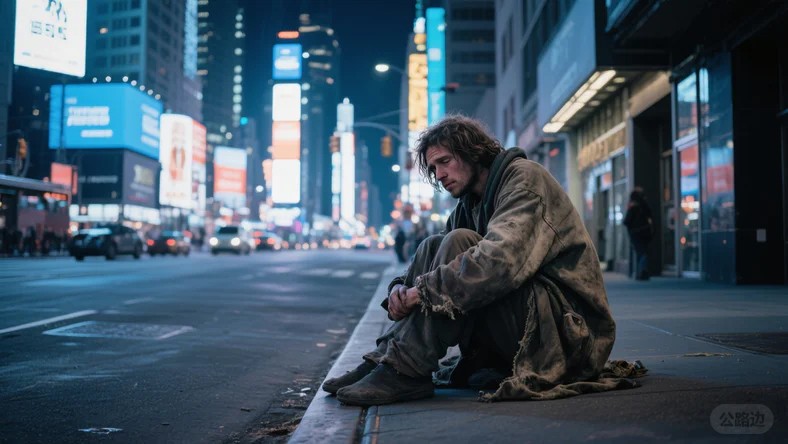
I remember Christmas 2018 in New York’s Times Square: street performers dancing in freezing wind, a small Black child struggling through choreography in the middle of the group. Sidewalk stalls sold low-quality bags and clothes. Crowds lined up for visibly unclean Mexican burritos. Subway floors were sticky and filthy. A homeless man near a vending machine offered to help me buy a ticket—then held out his hand for a tip after.
As a longtime fan of American TV dramas, this moment marked the beginning of my disenchantment with the U.S. Ever since, I’ve paid closer attention to details in films and shows—and realized Hollywood never actually hid these realities. The streets in movies weren’t cleaner than real life. I just hadn’t noticed before.
Looking back, I recall childhood tales claiming Americans could wear shoes on their beds because U.S. streets were so clean that shoes stayed spotless. Now, that sounds like dark comedy.
II. The “Kill Line” Is Not About Wealth Inequality—It’s About Institutional Support for Survival
At its core, the “kill line” debate concerns a society’s institutional capacity to prevent its most vulnerable from falling into fatal destitution. Many online commentators misinterpret this as purely a wealth gap issue—but that misses the point. According to the concept’s originator, “Lao A,” the “kill line” refers literally to physical elimination: once excluded from mainstream society, some individuals die within a short time.
The triggering event might be something as common as job loss or illness—experiences most people will face at least once in life. Why do such ordinary setbacks lead to death? We’ll explore that in the next section. Here, we focus on the issue of survival support.
In the U.S., losing your job and home often means becoming homeless. Homeless individuals face dramatically higher mortality rates due to natural disasters (floods, extreme cold or heat) and human-made dangers (drugs, crime).
Much of the online discussion centers on this contrast: for ordinary Chinese citizens, family and kin form a first line of defense. If that fails, taking a low-wage temporary job can restart the path to stability. If even that isn’t possible, urban communities offer assistance, and rural areas have poverty alleviation programs.
Large-scale unemployment primarily affects urban areas. In China, a significant portion of urban laborers are migrant workers who retain land rights in their rural hometowns. If unemployed, they can return home—where shelter and food are generally secure.
Urban residents face greater pressure, but native city dwellers (with multi-generational roots) usually own property. Even if they default on loans for their only residence, humane measures often ensure they retain basic housing.
What’s the fundamental difference between struggling Chinese citizens and their American counterparts? First, most Chinese in hardship still possess means of production or assets: rural land functions as productive capital, while urban housing holds potential value.
In contrast, Americans in distress typically own neither assets nor means of production. This reveals a deeper institutional divergence: China’s system ensures broad grassroots access to productive resources, and its grassroots governance retains the capacity to deliver precise, household-level support.
Many of America’s “fallen” were once middle-class—living respectably in cities but fundamentally proletarian. Renters own no assets. Even homeowners often hold properties burdened by mortgage debt. Once cash flow stops (due to job loss or income disruption), those “assets” vanish.
Some may ask: Isn’t the U.S. supposed to encourage private asset ownership, while China maintains state/collective land ownership? How did it end up feeling inverted?
Indeed, capitalist systems promote individual asset ownership—but precisely because they refrain from interfering in asset transfers. Without intervention, assets naturally concentrate. Those with more accumulate further; those with less can lose everything in a single crisis—never to recover, sometimes even perishing.
China experienced this dynamic for over two millennia before 1949. Our current land system draws lessons from that history—and from centuries of Western development—to suit the realities of socialism’s primary stage. It ensures that, during periods of insufficient productivity, the grassroots retain access to essential means of subsistence, while actively curbing excessive concentration of wealth.
This topic deserves far deeper exploration—but for now, let this suffice. We should recognize that China, over thousands of years—and especially during the past 150 years of modern upheaval—has experimented with countless systems and ideologies. These experiments are meticulously documented, and each generation of thinkers has reflected upon them.
Out of the darkness of modern history, these reflections have grown increasingly profound, practical, and scientific. We must cultivate confidence—not just in our material strength, but also in our culture and institutions.
III. Debt as an Accelerator of Downward Mobility
Earlier, we noted that triggers for the “kill line”—job loss, illness—are statistically probable life events. While such setbacks often cause financial strain and social decline, they rarely lead directly to physical elimination unless two conditions coexist: inadequate institutional safety nets and excessive personal debt.
When emergency savings can’t cover six to twelve months of unemployment—or even a major insured medical expense—the risk becomes existential.
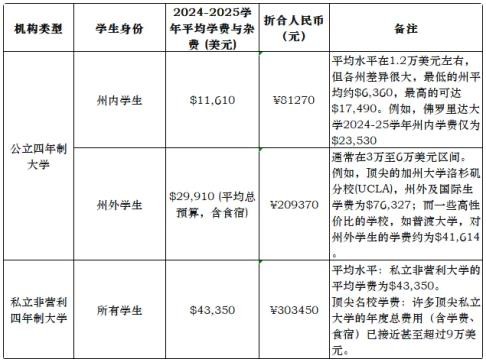
What debts do ordinary Americans carry? Unlike their Chinese peers, American youth typically graduate college already burdened by student loans. Tuition at U.S. universities is often unaffordable for middle- and lower-income families, making loans nearly unavoidable.
According to the College Board’s 2024–2025 data, average annual tuition at public and private nonprofit four-year institutions remains prohibitively high.
Soon after entering the workforce, due to poor public transit or long commutes, many take out auto loans. A few years later, with modest savings, they pursue homeownership—again, via debt. This assumes everything goes smoothly. In reality, America’s high cost of living makes it extremely difficult to cover rent, daily expenses, and loan payments while saving anything.
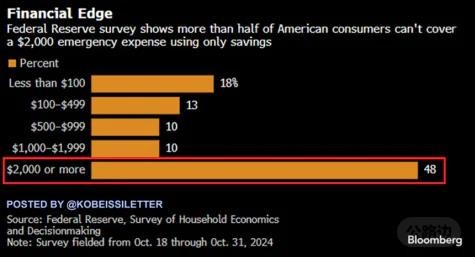
In a high-consumption, high-debt environment, personal and household financial buffers are dangerously thin. A Federal Reserve survey released June 7, 2025, found that 52% of U.S. consumers couldn’t cover a 2,000emergencyexpensewithsavingsalone.Moreover,31500 bill.
$2,000 certainly won’t sustain an unemployed American for half a year.
High income can’t compensate for high consumption and debt—without savings, there’s no net worth, and without net worth, there’s no resilience.
Is this high-debt, high-consumption model accidental? In a society that preaches “anyone can achieve the American Dream through hard work,” few consider systemic risks beyond individual control—like economic crises or industrial collapse.
Ordinary Americans face genuinely severe structural challenges. The tragedy is that this is baked into the system. For working-class youth seeking upward mobility through education, even the first step—student loans—is fraught with peril.
Meanwhile, life hasn’t been easy for ordinary Chinese people either in recent years. The hardest-hit are also those with high debt burdens—but crucially, China’s social and institutional safety nets (as discussed earlier) prevent outright “elimination.”
The U.S. thus serves as an extreme case study of a high-debt society—one offering vital lessons. An ordinary person who avoids excessive consumption and debt can likely maintain their social position. Choosing not to overextend during economic booms may mean missing some opportunities—but during downturns, it greatly increases the chance of survival.
Therefore, risk awareness is essential for anyone hoping to preserve their family’s long-term stability and avoid downward mobility.
As a blogger who has closely tracked China’s real estate market for years, I’ve acutely felt the pain debt inflicts on ordinary people. The U.S., as a paradigm of a high-debt society, offers a stark warning.
What we should gain from “disenchantment” isn’t just emotional reversal—but clearer cognition: recognizing the fundamental differences in how societies and systems uphold human life; seeing the deep risks debt plants during times of apparent prosperity; and understanding the critical importance of building personal and familial resilience against systemic shocks.
|

 Fear of God ESSENTIALS Hoodie Review: Mi86 人气#fashion
 The Derby of San Francisco Style 300 Cha112 人气#fashion
 Why the Derby of San Francisco Classic S130 人气#fashion
 Romaoss Launches "Rebirth Plan," in Talk70 人气#tech



 WeChat
 douyin