Nostalgia has finally blown onto Steam.
In recent years, more and more retro games have made their way onto the platform—titles like Flash Beat and World War Frontline, which we’ve covered before.
Just the other day, another heavyweight quietly launched: Ainodio 4, a legendary early smartphone RPG originally released in 2012.
If you didn’t play Ainodio 4 back then, it’s hard to grasp just how groundbreaking it was.
In 2012, smartphones hadn’t yet fully taken hold in China. The domestic mobile gaming scene was still obscure, dominated by casual titles like Where’s My Water?, Plants vs. Zombies: Tower Defense, Fishing Joy, and Angry Birds—the must-have apps of the era.
Amid this landscape, Ainodio 4, a dark fantasy ARPG, stood out as a globally recognized premium mobile title.
This isn’t hyperbole. Most Chinese players who encountered this single-player, in-app-purchase RPG played pirated, fan-translated versions—or even used cheat tools like “Ba Men Shen Qi” (Eight Gates Godly Artifact) to modify game data themselves.
Thirteen years later, communities on TapTap and other platforms are still bustling with players exchanging strategies, showing off merchandise, and pleading for the developer to revive this dormant franchise with a sequel.
Even seasoned mobile gamers would struggle to name another single-player mobile game from over a decade ago that commands the same enduring devotion as Ainodio 4.
What was the story of this game many never finished? Why was there never a sequel? And will we ever see Ainodio 5 in our lifetime? Let’s unravel these childhood mysteries one by one.
Since it’s called Ainodio 4, most assume there must be Ainodio 1, 2, and 3. That’s partly true—but not entirely.
There were indeed four numbered entries, but only Ainodio 2, 3, and 4 truly belong to the core Ainodio IP.
Here’s the backstory: the original Java-based Ainodio launched in 2007 on Korea’s three major mobile download platforms—SKT, KTF, and LGT. That same year, Steve Jobs unveiled the iPhone in California, a device that would reshape society.
To capture the emerging iOS market, developer Com2uS began porting its older titles to the new platform.
It rebranded its earlier title Fenno Legend 2 as Ainodio Chronicles: Fenno Legend for iOS.
Meanwhile, the 2007 Java original was relaunched on iOS as Ainodio 2: Ron the Wanderer, shifting from tap controls to a four-directional virtual joystick—a control scheme carried forward in all subsequent entries.
The Ainodio series quickly became an industry benchmark. By late 2008, the paid single-player Ainodio Chronicles: Fenno Legend surpassed one million downloads within days. Ainodio 2: Ron the Wanderer (2009) won Best Game from the veteran U.S. mobile site 148Apps. Ainodio 3: Heir of Cania ranked second for Best Role-Playing Game (Android) in 2011.
The final installment, Ainodio 4: Assassin of Belser, released in late 2012 after more than two years of development, crossed five million downloads—on Google Play alone, excluding iOS and countless pirated copies. So while exact figures are elusive, its success is undeniable.
More telling is the fact that, over a decade later, player demand has never faded. Few would dispute that Ainodio 4: Assassin of Belser was a triumph.
One hallmark of the Ainodio series is that each game features a standalone story with different protagonists, all set within the same overarching world.
Ainodio 2: Ron the Wanderer follows the descendant of a hero who defeats a resurgent demon king to save the continent. Intriguingly, the demon king isn’t actually from the demon race—and timid demon NPCs beg the hero to seal him away, hoping for true peace among demons.
Ainodio 3: Heir of Cania centers on the young Lu Sen and his friends as they gather legendary gear to stop a dark cult from resurrecting a dark god.
But Ainodio 4: Assassin of Belser delivers the most memorable narrative. Here, the protagonist isn’t a hero—but Kane, an assassin from the very dark cult that served as the antagonist in Ainodio 3. During a mission, Kane meets the holy maiden Eusia, and the two embark on an adventure together.
As their journey unfolds, Eusia falls in love with Kane, whose personality gradually softens. He also uncovers his true origins. Yet a union between light and darkness seems impossible. In the end, Eusia sacrifices herself to save Kane—who is then mysteriously teleported to an unknown place.
The open-ended, bittersweet conclusion wasn’t even the worst part for fans. What truly stung was what came next.
Those hoping Ainodio 5 would resolve the cliffhanger didn’t get a sequel announcement—they got a gut punch.
On the afternoon of March 7, 2013, Com2uS declared at its annual product launch event that, due to development costs, revenue concerns, and industry trends, it would cease producing single-player RPGs entirely. The company would shift focus to social and card-based games.
Thus, Ainodio 4: Assassin of Belser—left without closure—became a lingering wound for countless fans.
Search online for “Ainodio 5,” and you’ll find legions of players still waiting for an ending that may never come. Some have even begun writing their own continuations.
Meanwhile, Com2uS—the world’s first Java mobile game developer, founded in the late 1990s—did achieve success after abandoning single-player RPGs. But its trajectory hasn’t resonated with Chinese players, and regulatory factors have kept it under the radar domestically.
Its baseball-themed MLB mobile series remains a genre leader; last month alone, the 2012 MLB title earned 500,000.?SummonersWar:SkyArena?(2014)hasgrossedover3 billion in ten years.
Yet Com2uS suffers from a lack of new hits and declining performance—essentially living off past glory. Not shameful, perhaps, but telling.
Dig deeper into Com2uS’s financials, however, and a troubling picture emerges: the company has been in prolonged losses, with its stock price now back to levels seen a decade ago.
Where did the money go?
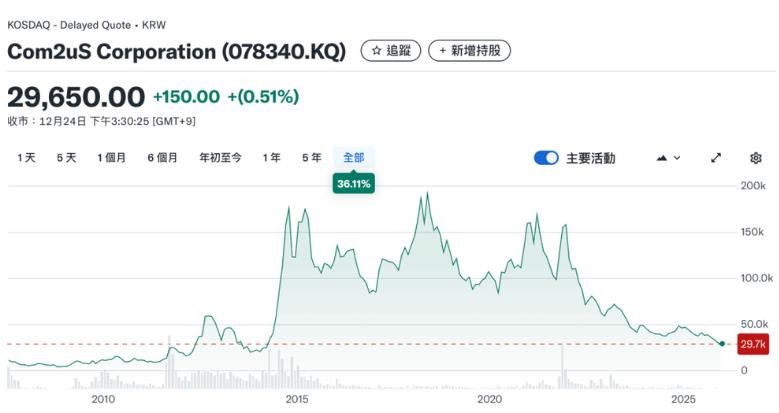
Simple: it was poured into investments—some profitable, others total write-offs.
As the saying goes, “A big company never sits still.” Com2uS, a major Korean publisher, certainly fits the mold. Its abrupt abandonment of Ainodio already signaled its restless nature.
Some ventures succeeded—like diversifying into entertainment.
In 2019, Day Seven, a Com2uS subsidiary, saw its narrative game Targeted by Delinquents adapted into a webtoon and web drama. In 2022, Com2uS co-produced the hit K-drama Reborn Rich.
But entertainment is volatile. In its 2024 earnings report, Com2uS cited underperforming media content as a key reason for losses—alongside rising costs in HR, operations, marketing, and market expansion. These are understandable setbacks.
Less comprehensible was its dive into NFTs. Though given Korea’s crypto frenzy, the move makes sense.
Com2uS didn’t dabble—it went all-in, launching its own NFT platform, Com2Verse.
Initially, the NFT push even boosted its stock price. But the losses soon piled up.
In Q2 2022, Com2uS Holdings reported a net loss of 31.7 billion KRW (~24million),blaming“virtualassetimpairments.”InH12023,theNFTdivisionlost6.2 million, triggering layoffs. By early 2024, another 100+ staff were cut from the platform—still bleeding red ink.
Yet Com2uS refuses to quit NFTs. Clearly, it’s a committed relationship.
This explains the stock’s dismal performance: losses consistently outweigh profits.
In March 2024, Korean media attributed Com2uS’s three-year stock decline to its 2021 media ventures failing to meet profit expectations. Whether other factors are at play is up to interpretation.
From 2022 to 2024, Com2uS posted positive operating profit only in 2024 and net profit only in 2023. Under such conditions, a stock rally would be miraculous.
That March, reports claimed Com2uS would boost its share price through multiple new game launches. Today, it’s clear: all those efforts failed.
Back to the original question: will we ever see Ainodio 5?
There’s a slim chance—but don’t get your hopes up.

Single-player games are surging again in Korea, thanks to hits like Stellar Blade and Lies of P. This revival offers a glimmer of hope.
Optimists might see Ainodio 4’s recent Steam release as a sound out —a test of interest.
But honestly, Com2uS has mishandled this golden legacy. We’re not asking for a remake—just a decent port. Instead, we got terrible optimization and rampant bugs.
Out of sheer nostalgia, players left 289 reviews with an 80% positive rating. That’s generosity, not quality.
Whatever happens, I only hope Com2uS treats Ainodio with the respect it deserves.
For a generation, it was the white moonlight of the smartphone gaming era—the embodiment of youth now gone.
|

 Fear of God ESSENTIALS Hoodie Review: Mi83 人气#fashion
 The Derby of San Francisco Style 300 Cha108 人气#fashion
 Why the Derby of San Francisco Classic S127 人气#fashion
 Romaoss Launches "Rebirth Plan," in Talk65 人气#tech



 WeChat
 douyin