Lee Jae-myung’s Visit to China Likely to Improve Bilateral Ties, but Security Issues Unlikely to See Breakthrough
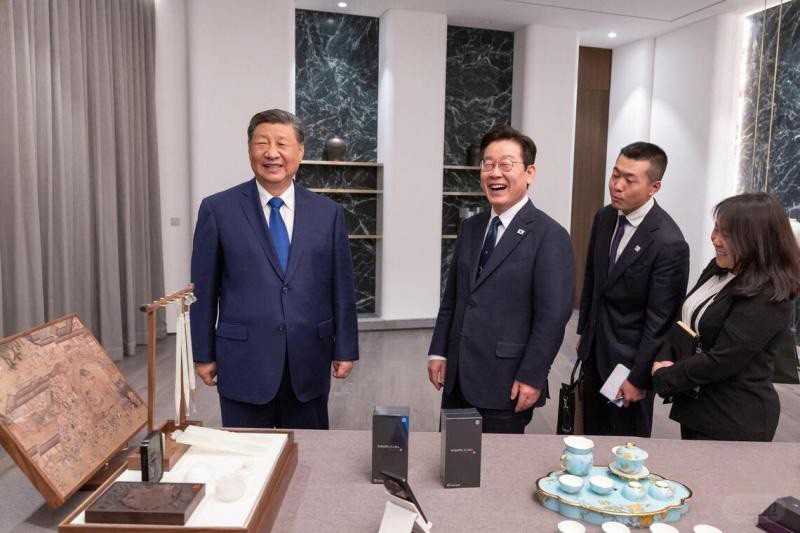
On November 1, 2025, South Korean President Lee Jae-myung (second from left) and Chinese President Xi Jinping (leftmost) exchanged gifts during the Asia-Pacific Economic Cooperation (APEC) meeting in Gyeongju. (AFP)
South Korean President Lee Jae-myung began a four-day state visit to China on Sunday, January 4. Against the backdrop of escalating tensions in Sino-Japanese relations and across the Taiwan Strait, Beijing is expected to seek Seoul’s alignment on Japan and Taiwan-related issues, while South Korea aims to secure Chinese support on bilateral economic cooperation and the Korean Peninsula.
Scholars interviewed assessed that bilateral relations are likely to improve, but neither side will be fully satisfied with the other’s stance on international relations and security matters. Due to the U.S.-South Korea military alliance, Seoul finds it difficult to significantly adjust its position on Sino-Japanese or Taiwan issues; for Beijing, the Korean Peninsula issue is deeply entangled in U.S.-China geopolitical competition, making it hard to offer Seoul clear commitments.
According to South Korean media reports, Lee will arrive in Beijing on Sunday and meet with Chinese President Xi Jinping on Monday, followed by a two-day visit to Shanghai.
This marks the second mutual visit between the two leaders within just two months—their previous meeting took place during last November’s APEC summit in South Korea. It is also the first state visit by a sitting South Korean president to China since 2019. Lee is the first foreign leader received by the Chinese government in 2026. Following his China trip, he will visit Japan later this month.
Prior to his visit, Lee gave an interview to China Central Television (CCTV) at the Blue House. According to CCTV’s Chinese transcript, Lee stated that the purpose of his visit is “to minimize or eliminate past misunderstandings or conflicts with China and elevate ROK-China relations to a new stage.”
Lee noted that although there has been a saying in the past that “security relies on the U.S., economy relies on China,” this does not mean ROK-China relations should inevitably drift toward confrontation or conflict—a scenario that would serve no benefit to South Korea’s national interests. He suggested that leaders of both countries aim to meet at least once a year.
On the Taiwan issue, he reaffirmed the one-China principle, stressing that maintaining peace and stability in Northeast Asia—particularly regarding cross-strait issues—is of critical importance.
When asked how the two countries should jointly commemorate and pass down “the shared historical memory of fighting side by side for national independence,” Lee did not explicitly name Japan. He only said that the historical experience of China and South Korea resisting aggression and struggling together is invaluable, adding, “We cannot remain stuck in the past. For a better future for our peoples, we must continually seek new possibilities to move forward together.”
South Korean media reported that Lee will visit the former site of the Provisional Government of the Republic of Korea in Shanghai, established during Japan’s colonial rule. According to Chosun Ilbo, citing unnamed sources, Beijing may use this part of Lee’s itinerary to “convey the message that China and South Korea were comrades-in-arms against Japanese imperialism.”
Since South Korea deployed the THAAD missile defense system in 2016, many South Korean businesses have withdrawn from China, and the “Korean Wave” has faced setbacks in the Chinese market. Bilateral relations have yet to fully recover. A recent Chosun Ilbo survey published Saturday showed that South Koreans’ favorability toward China has dropped to half of what it was a decade ago.
Associate Professor Li Mingjiang of Nanyang Technological University in Singapore and Professor Kang Jun-young of Hankuk University of Foreign Studies, who also serves as Chairman of the Northeast Asia Future Cooperation Forum, both believe that ROK-China relations will improve following the leaders’ meeting, but progress on international and security issues will remain limited.
Kang told Lianhe Zaobao that due to the U.S.-ROK military alliance, Seoul finds it difficult to substantially shift its stance on Sino-Japanese or Taiwan-related issues. On Taiwan, South Korea will merely reiterate its one-China position without going further than before. He also cautioned that China’s attempt to draw South Korea into countering Japan could undermine regional stability, as simultaneous tensions among China, Japan, and South Korea would create more opportunities for North Korea to exploit.
Li Mingjiang noted that while the North Korea issue—especially concerns over potential additional nuclear tests—is Seoul’s top priority, Beijing views it as inseparable from broader U.S.-China geopolitical rivalry. Therefore, China is unlikely to make concrete commitments, offering at most diplomatic reassurances to Seoul.
Regarding bilateral ties, Kang believes both sides could achieve tangible outcomes in supply chains, semiconductors, rare earths, and people-to-people exchanges. He added that if civilian exchanges can be promoted and mutual understanding enhanced—ensuring neither side is misled by fake news—“that would be the greatest achievement for ROK-China relations.”
Wang Yiwei, Director of the Institute of International Affairs at Renmin University of China, analyzed that Seoul is trying to “pick low-hanging fruit” from China amid Sino-Japanese tensions, but there isn’t much fruit to pick. He pointed out that China and South Korea are competitors in scientific research, though South Korean cosmetics and tourism may still appeal to Chinese consumers. As China opens up sectors like healthcare and education during its upcoming “15th Five-Year Plan” period, South Korean companies might find some business opportunities.
According to Yonhap News Agency, an economic delegation comprising over 200 South Korean business leaders—including Samsung Electronics Chairman Lee Jae-yong, SK Group Chairman Chey Tae-won, Hyundai Motor Group Chairman Chung Eui-sun, and LG Group Chairman Koo Kwang-mo—will accompany President Lee on his China visit.
|

 Fear of God ESSENTIALS Hoodie Review: Mi86 人气#fashion
 The Derby of San Francisco Style 300 Cha112 人气#fashion
 Why the Derby of San Francisco Classic S130 人气#fashion
 Romaoss Launches "Rebirth Plan," in Talk70 人气#tech



 WeChat
 douyin