努力挣钱买把伞    发表于  昨天 13:54 | 显示全部楼层 |阅读模式 18 18
How to view mainland China's 2025 Human Development Index (HDI) of 0.797, which is lower than that of Thailand, Iran, Malaysia, Armenia, and other countries?
Source: Country Insights | Human Development Reports
Reference data: HDI: Thailand 0.798, Iran 0.799, Malaysia 0.819, Armenia 0.811, Russia 0.832, Serbia 0.833, Kazakhstan 0.837, Georgia 0.844, Bulgaria 0.845, Romania 0.845, Turkey 0.853, Argentina 0.865, Hungary 0.870

Gary    发表于  昨天 13:55 | 显示全部楼层
Propaganda work isn't about portraying the enemy as utterly worthless—that’s not effective. Over-exaggeration often backfires.

For example, if you wanted to argue that Kobe Bryant wasn’t good at basketball, you could present various career statistics showing he was inferior to LeBron James. Many people might support your view, while others would oppose it, leading to heated debates.

But if instead, you pulled out some wildly obscure data claiming that Cai Xukun, after only two and a half years of practice, reached such a basketball level that Kobe’s natural talent was clearly inferior to Cai’s—everyone would just burst into laughter.

The same logic applies here. If Western countries genuinely want to discredit China, they should at least compare China with places like South Korea, Japan, or Taiwan. Regardless of actual living standards, these places do have per capita GDP figures that are objectively higher than China’s, giving their arguments at least some credibility.

Yet what we’re seeing now is something completely absurd. This reveals that the ideological propaganda apparatus of the Western world has already decayed to a laughable degree. We used to think Western propaganda was powerful, but in reality, its effectiveness has always relied on overwhelming information volume and decades-long cultural hegemony. In truth, their propaganda sector—just like other Western institutions—has long been hollowed out by all sorts of "Commissioner Smiths." They receive exorbitant budgets every year, yet right before deadlines, they scramble to assign a few interns—or even outsource the work—to hastily cobble together a few shoddy articles. The templates and data they use haven’t been updated in twenty years. They’re nowhere near the calculated, meticulous standard set by Goebbels.

Trump cutting their funding was absolutely justified.

These people care only about making money; they no longer care whether their propaganda actually works. As long as they’re paid enough, they’d even be willing to flatter China. They’re nothing but a disorganized mob of sycophants trailing behind a cult leader—ready to scatter at the first sign of trouble.

To China’s liberals, pro-American factions, believers in the “free world,” and anti-establishment groups: if you truly want to accomplish anything meaningful, take my advice—cut ties with these scoundrels as soon as possible. Stop constantly citing garbage articles these vermin slapped together in a few days. Put in some real effort yourself: collect solid data and write pieces that at least make logical sense, okay?
Sage    发表于  昨天 13:55 | 显示全部楼层
I don't quite agree with the value of 0.797, but I feel relieved when I see it lower than countries like Thailand and Iran.

This feeling is like

The top ten generals of World War II may not be Chinese, but they are like MacArthur
Richard    发表于  昨天 13:56 | 显示全部楼层
I can’t laugh—it’s tears welling up inside me. I really did study humanities in Europe and, through Erasmus, met quite a few people from so-called developed Western and Northern European countries.

This whole discursive framework defines the West as advanced and developed, leaving all non-Western nations without any voice—only to be defined, only to be gazed upon by the West. The only way for you to move up a few spots on their rankings is to emulate the West. But honestly, this game is becoming harder and harder to sustain today. With short videos and the collapse of traditional filters, it’s not just East Asians who are starting to question many things—even people within Europe and North America are beginning to doubt. Take, for example, the recent rift between the EU and the U.S.

One day, a Polish colleague suddenly asked me: “Is the U.S. really that developed?”

I replied, “When I visited in 2016, it was okay—the locals were nice enough, but the infrastructure didn’t leave much of an impression on me. It was pretty average.”

She followed up: “Could it be that what we’ve seen is just propaganda? Maybe the U.S. was never actually that developed?”

I said, “Absolutely. Contemporary America has many serious problems—its infrastructure, public safety, and services in many areas have already fallen behind China.”

She then asked, “But what about 20 or 30 years ago? Was the U.S. really ahead of China back then? Could that also have been propaganda?”

I hesitated and said, “Independent thinking is good, but your step might be a bit too big. As a Chinese person, I know clearly what things were like 20 or 30 years ago. Back then, the U.S. was genuinely strong overall, and its cultural output powerfully demonstrated its comprehensive strength.”

The HDI is just one symptom. In humanities departments across the EU and North America, there exists a self-contained ecosystem of databases and research archives. Whenever they address other countries, they barely even pretend—they openly adopt a Eurocentric stance. The West defines the direction of advancement, while the rest of the world, especially the East, is reduced to passive followers, completely voiceless. How can you expect students graduating from such a system to possess genuine critical awareness?

Some professors lecture with arrogant gazes toward the East, disdainful of the so-called Third World, recycling Cold War–era ideological animosities. Their students, in turn, lack any independent judgment—their views are shallow, ignorant, and confined within the information bubbles of their own linguistic spheres.

In short, rankings like these aren’t worth taking seriously. Let them keep sleeping in the dark. The moment the West loses its discursive authority and credibility, this whole edifice will collapse on its own.
白宪武    发表于  昨天 13:57 | 显示全部楼层
Massive, low-quality humanities-oriented higher education under the "Ri Er Man" (Western) system
is nothing but a national disaster.

Take Nigeria, where I live, for example: a population of 200 million, with four to five million university students.
It’s a so-called “American-style democracy,” an English-speaking country, rich in natural resources, obsessed with educational credentialism, filled with government officials who are all graduates of top Western universities, located on the coast, and blessed with major rivers.

At independence in 1960, its GDP was far higher than China’s.
Sounds impressive, right?

But here’s the problem: undergraduate computer science students have never taken a course in computer architecture. They’ve never learned C—they only know how to make websites.
Their graduate-level courses are even simpler than those at China’s second-tier universities.

Finance undergraduates don’t understand how money is issued or how central banks work.
Economics undergraduates can’t explain the causes and background of the China-U.S. trade war.

Ask them what they do at school, and they’ll say: watch sports, hang out, join campus clubs.
What do they discuss on campus? Democracy, freedom, environmentalism, feminism, LGBT rights.

When they protest, they just chant, “The people suffer! The people are hungry!”—yet nobody studies agronomy.

All practical fields—engineering, agriculture, medicine—are severely understaffed, not because people don’t want to study them, but because these programs simply aren’t offered.

Instead, everyone floods into “talk-the-talk” majors: economics, public administration, management, finance, law, and computer science. Computer science isn’t technically “just talk,” but there are no jobs for them anyway.

Tuition isn’t cheap either—around 4,000 to 5,000 RMB per semester.

And the result?
A bachelor’s degree holder earns a salary of 400 (local currency units), a master’s graduate maybe 500+.
Meanwhile, factory workers, excavator operators, and truck drivers earn over 800.
Mechanics on the roadside make 1,000+.
Even cooks earn 800–1,000.

Yet, according to the Human Development Index (HDI), these skilled workers rank lower than those so-called “university graduates.”
Gabriella    发表于  昨天 13:57 | 显示全部楼层
I've discussed this issue with international users on Reddit, and the general consensus was that China's PPP data is problematic. As the world's largest manufacturing nation, China should theoretically have a significant advantage in PPP terms, yet this isn't reflected in the data at all. According to the figures, mainland China's price levels are comparable to those of Hong Kong—a highly developed economy with virtually no manufacturing.

Since PPP-related data is voluntarily reported by countries, foreign netizens believe this data has been manipulated by Chinese authorities, deliberately understating it to avoid international pressure that would come with being classified as a "developed country."
Payton    发表于  昨天 13:58 | 显示全部楼层
I remember before the subprime mortgage crisis, there was a post on Tianya (a Chinese online forum) about a Western-compiled global happiness index ranking. Russia was ranked dead last, while Iceland was ranked first.

Then the subprime crisis hit. Iceland had previously attracted deposits from countries like the UK and France with high interest rates and invested that money aggressively. When the investments collapsed, Iceland planned to let its banks go bankrupt and default on the debts. But the UK wouldn’t allow it and insisted Iceland repay the money.

The world’s “happiest” country, Iceland, had neither industry nor agriculture—its only real industry was fishing. The UK exploited this weakness: if Iceland didn’t repay, it wouldn’t be allowed to fish. Faced with this, Iceland had no choice but to borrow money to pay back its debts. I’m not sure exactly which countries lent to it, but the most striking one I remember was Russia—the country ranked dead last in the global happiness index...
超人刘    发表于  昨天 13:58 | 显示全部楼层

先说结论:平均受教育年限(mean years of schooling)一项拉低的中国的人类发展指数(Human Development Index)数据。


看了一圈竟无一个回答指出这点,实在令人失望。人类发展指数的计算公式是公开可查的,其报告引用的数据也都是公开的。质疑具体引用数据的准确性,或质疑该指数的计算公式是否合理,都是可以的。从 1990 年联合国开发计划署(UNDP)发布这个指数,到 2010 年改新算法,对算法的质疑一直都存在。本文不涉及对于具体算法是否合理的讨论,仅以计算角度来说明它是如何得出的。


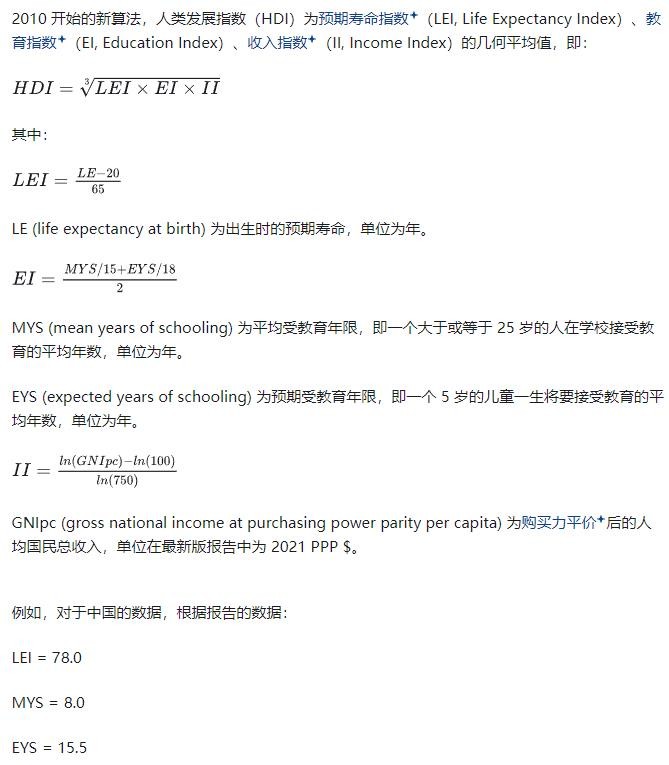
2010 开始的新算法,人类发展指数(HDI)为预期寿命指数(LEI, Life Expectancy Index)、教育指数(EI, Education Index)、收入指数(II, Income Index)的几何平均值,即:

360截图20251222140006119.jpg
360截图20251222140013486.jpg

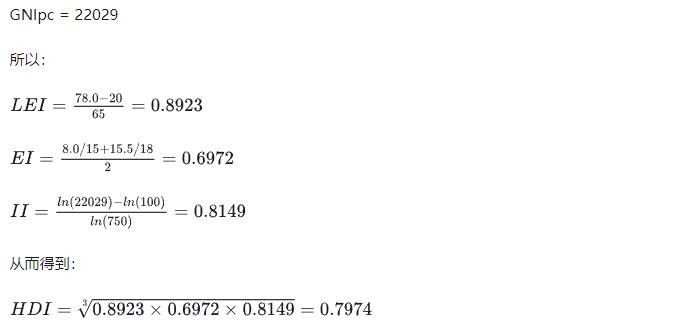
与报告上所得的值相同,有兴趣的话也可以选择感兴趣的国家自行验算。

接着是比较题中所说的几个国家和中国的数据:
国家LEIMYSEYSGNIpcHDI
中国78.08.015.5220290.797
泰国76.49.015.4205700.798
伊朗77.710.814.0160960.799
马来西亚76.711.112.7325530.819
亚美尼亚75.711.314.4202210.811
可见中国在预期寿命中排五个国家中的第一,预期受教育年限排名第一,购买力平价后的人均国民总收入排名第二,唯独平均受教育年限一项排名垫底,显著拉低了总的人类发展指数(实际上也没差多少)。
因此结论就很明确了:平均受教育年限一项拉低的中国的人类发展指数数据。
值得注意的是,预期受教育年限与平均受教育年限的排名恰好五个国家中一个第一,一个垫底,这恰恰说明了教育的发展是很快的,只不过由于是后发国家,所以有许多年龄比较大的人受教育水平不如其它这几个国家。
这就是数据分析的结果,当然,读者可以认为人类发展指数的公式设置不够合理,特别是对于后发国家,“平均受教育年限”一项不够公平,这就是见仁见智的问题了,也非本回答所涉及的。

以上。

参考:


人类发展指数 2025 报告:https://hdr.undp.org/system/fil


心痛的滋味    发表于  昨天 13:59 | 显示全部楼层
I saw a highly upvoted answer that seemed quite reasonable at first glance, so I’m writing this specifically to offer a counterpoint.

Praising China superficially—saying things like “China has made great progress”—while simultaneously manipulating data in practice to deliberately downplay China’s achievements, thereby making its progress appear “not that significant,” is not contradictory at all.

The original answer’s introductory “background” isn’t entirely wrong. The United Nations Development Programme (UNDP), which compiles the HDI, is indeed not an anti-China organization; historically, its relationship with China has even been fairly positive.

However, every single UN agency—without exception—is staffed by personnel from nearly 200 member states with vastly divergent interests. Coupled with internal bureaucratic infighting within the UN system, it’s extremely common for a single agency to host multiple factions with sharply opposing positions coexisting over long periods. This is nothing unusual.

It is highly likely that the specific team responsible for compiling the HDI is dominated—or at least heavily influenced—by individuals who actively seek to “suppress” China’s performance metrics. These individuals wield enough influence to enable systematic manipulation of China-related data over an extended period.

A friend of mine, as early as more than ten years ago, uncovered that the 2013 Human Development Report used unverified and suspiciously low figures for China’s basic indicators.

Recently, a friend asked me: “Does China or Vietnam have a higher life expectancy?” Based on both countries’ development trajectories and my own travel experience, I immediately answered: China. But my friend showed me the UN’s 2013 Human Development Report, which clearly stated Vietnam’s life expectancy was 75.4 years, while China’s was only 73.7 years. Stunned by this counterintuitive claim, I looked up the report myself and confirmed the UN Department of Economic and Social Affairs indeed published those numbers. To verify further, I checked the World Health Organization (WHO) website—the world’s most authoritative health body—and accidentally discovered a serious discrepancy.

According to WHO data, China’s life expectancy had already reached 76 years in 2011, while Vietnam’s remained at 75 years. Moreover, for other major developed countries and the other three BRICS nations, the UN report’s figures aligned closely with WHO data—only China showed a massive gap.

Take mean years of schooling—the average number of years of education received by people aged 25 and above. According to China’s 2010 Sixth National Population Census, the average educational attainment for those aged 15 and above had already reached 9.05 years—let alone for those aged 25 and above. Yet the UN report used a figure as low as 7.5 years.

Expected years of schooling refers to the number of years of education a child entering school today is expected to receive. The UN report listed China’s expected years of schooling in 2011 as 11.7 years. However, China’s National Outline for Medium- and Long-Term Education Reform and Development (2010–2020), released in 2010, already stated that in 2009, the average education level of new entrants to the labor force was 12.4 years. Projecting forward based on current enrollment rates, it estimated that by 2020, this figure would reach 13.5 years. In other words, children entering school in 2011 would, by age 25, have completed an average of 13.5 years of education.

If one could excuse this as “inexperience” or unfamiliarity with authoritative Chinese data sources back then—how can the exact same errors persist unchanged into 2025?

Does that “rational” respondent genuinely believe such explanations?
Jasmine    发表于  昨天 14:06 | 显示全部楼层
近年来的人类发展指数我还真经常翻,这个报告其实是挺有意思的。

首先,它不是一个“根据约翰霍普金斯大学”的报告。它是由中国担任五大常任理事国之一、被以色列公开diss了不知多少次、经常被人嘲讽为五常一冲突就会没了的那个联合国,下设的开发计划署出具的报告。也就是说,它至少不是一个传统上完全被掌握在欧美媒体口中的反华宣传渠道。

恰恰相反,自从90年代发布以来,中国在这个榜单上的排名每年都在进步,目前距离最高评级的“极高人类发展水平国家”(也就是普通人生活质量意义上的发达国家)已经触手可及。而刚刚发布的时候,中国只是个“低人类发展水平国家”,属于最低的一档。几十年来,从低等跨入高等的国家只有为数不多的几个,而如果中国进入了极高组,将会成为全世界独一无二的从最低等级跃升到最高等级的国家。因此,开发计划署对中国的发展进步,是给予很高评价的。

其次,它不会因为你月薪3000、买了烂尾楼、彩礼要掏空钱包这些事情打低分,也不会因为你的国家有多少基建、科技、军事实力而打高分。作为一个需要把最发达的和最落后的国家都纳入考量的评价体系,它关注的是最基本的生活指标也就是温饱、教育、寿命等等。所以,无论是对于认为中国人生活质量已经够高还是观点相反的人,有些指标的排名都可能会出乎意料。

第三,前面有朋友提到了,这个指标不仅仅考量“当前发展水平”,还考量“历史累积发展水平”,最典型的就是人均受教育年限。这一条对中国来说是非常吃亏的,也就造成了中国除了这一项之外的几乎每一个分项评分都高于自己前后排名接近的国家。但这属于历史欠债,而我们的历史欠债确实太多了。

那么是不是全世界都在发展、中国跟着水涨船高了呢?

当然有这个因素,2015年的极高组只有49个国家,2025年则已经有了74个,甚至能出现俄罗斯这种明明从高组进步到了极高组、排名却在不断下滑的奇景。但是,我们讨论的是中国在排名上的持续进步和“为数不多的从低等进步到高等”,这两件事都已经说明了问题,而联合国已经发出警告,极高组和低组的差距已经连续4年都在拉大,世界各国家地区的发展水平并没有变得更加公平,反而是落后国家被甩得更远了。

最后,我个人的观点,这个排名确实有些指标挺让人蚌埠住的,比如后面我会讲讲这里面的性别发展相关排名,亮点可太多了。

2025年人类发展指数报告见链接:

https://hdr.undp.org/content/human-development-report-2025


目前完整报告只有英文版,后续会有中文版。

先看看总排名。

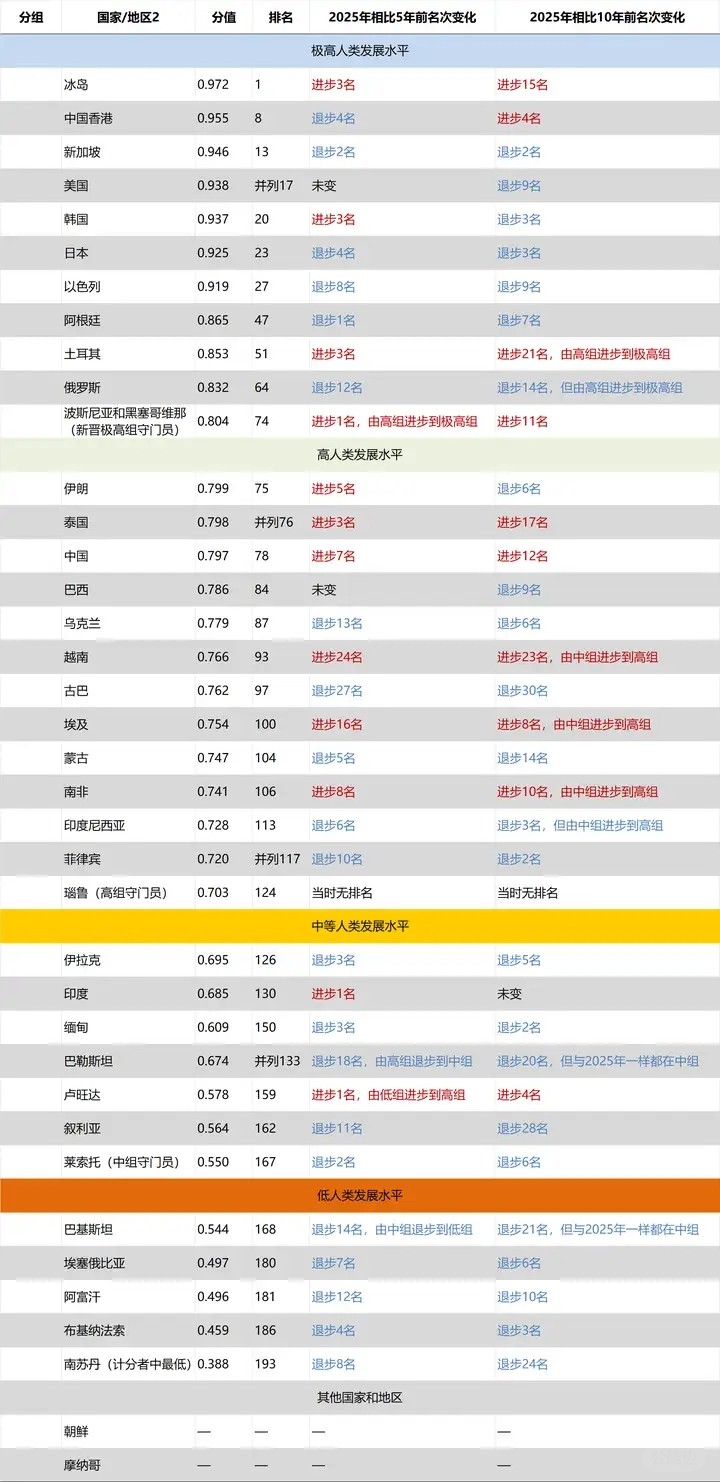
人类发展指数共设四个等级:低人类发展水平,中人类发展水平,高人类发展水平,极高人类发展水平。中国2025年的数据为0.797,排第78名,在第二级“高人类发展水平”组排名第4,落后于伊朗(0.799)、圣文森特和格林纳丁斯(0.798,这是东加勒比地区的一个小岛国)、泰国(0.798)。

达到0.8就可以进入极高组,从这一点来看,如果不发生战争、coup等不可抗力,伊朗、泰国、中国在未来几年都有这个可能。

表太长,我就先拿Excel列几个典型代表吧:
01.webp.jpg


12下一页
您需要登录后才可以回帖 登录 | 立即注册

Archiver|手机版| 关于我们

Copyright © 2001-2025, 公路边.    Powered by 公路边 |网站地图

GMT+8, 2025-12-23 22:19 , Processed in 0.137410 second(s), 31 queries .