独孤梦    发表于  前天 14:06 | 显示全部楼层
China's mean years of schooling severely drags down its HDI—only 9.9 years, significantly lower than many other countries.

This indicator is actually highly problematic. If you change it to "average instructional hours," you'd immediately understand why China has developed so rapidly: for the same nominal "one year" of curriculum, China delivers more than twice the instructional time compared to Malaysia...
David    发表于  前天 14:07 | 显示全部楼层
What’s actually more worth examining is how this PPP is calculated.

Why does Malaysia’s PPP reach 32,000, far exceeding China’s 22,000?

When I traveled in Malaysia, I clearly felt that prices there aren’t cheap, and incomes aren’t higher than in China.

At the same income level—especially at lower income levels, say around 5,000—the material standard of living in China is significantly better than in Malaysia.
Owen    发表于  前天 14:08 | 显示全部楼层
The HDI calculation formula is highly transparent and reasonably scientific. Therefore, blaming bias or attacking the United Nations is simply misdirected.

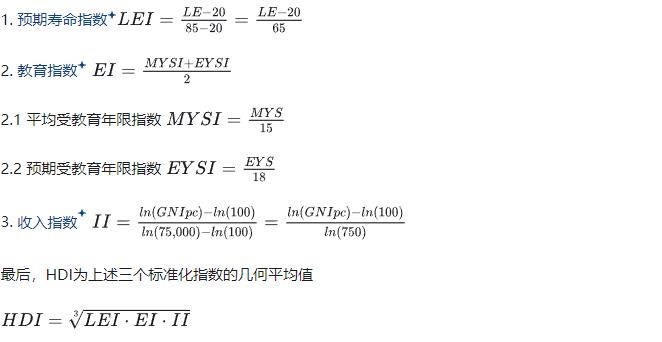
The real problem lies in the data. The HDI formula relies on four key indicators: life expectancy at birth, mean years of schooling, expected years of schooling, and gross national income (GNI) per capita adjusted by purchasing power parity (PPP). Many highly upvoted answers obsess over "mean years of schooling," completely ignoring the two truly problematic indicators: expected years of schooling and GNI per capita (PPP).

Expected years of schooling: This refers to the number of years of education a five-year-old child is expected to receive—including preschool. China’s figure is 15.5, meaning a Chinese five-year-old is expected to finish exactly high school. I won’t even comment on how absurd that is—but what’s more baffling is that both Turkey and Argentina reportedly have higher values than China on this metric...

GNI per capita (PPP): While China’s nominal GNI per capita isn’t particularly controversial, the PPP adjustment is deeply problematic. PPP can be loosely understood as a measure of price levels. In this dataset, China’s average price level is listed as 80% of Hong Kong’s—and even higher than Taiwan’s. (Preemptive clarification: housing prices are not directly included in PPP calculations; instead, construction costs are estimated using prices of materials like steel and cement—essentially excluding actual real estate market prices.)

Two out of the four core inputs are flawed, so naturally the final HDI result is inaccurate. Yet paradoxically, these four data points are actually submitted to the UN by the Chinese government itself—especially the price-level data, for which China chose to collect samples from city centers in Beijing and Shanghai. Moreover, back in 2014, when China’s PPP-adjusted GDP surpassed that of the U.S., official media outlets like Xinhua published a series of articles arguing that China’s price levels were underestimated and its PPP overestimated, insisting that China was still far behind the U.S. (These articles can still be found online today.)
Adeline    发表于  前天 14:09 | 显示全部楼层
Let me add a bit of context about the Commonwealth of Independent States (CIS) countries. In the Soviet Union, university students essentially paid no tuition and received a monthly living allowance equivalent to the local minimum subsistence level during their studies. Additionally, they could work during holidays in student construction brigades, earning quite decent wages. As a result, there was little incentive to graduate early and enter the workforce.

For example: if Beijing’s current minimum living standard is 2,500 RMB per month, then under the Soviet system, every undergraduate student studying in Beijing would receive at least 2,000 RMB per month as discretionary living allowance from the state—possibly 3,000 RMB for students in high-demand majors. During holidays, they could join state-run construction brigades, typically doing office-based drafting or clerical work, earning around 9,000–10,000 RMB per month.

Moreover, Soviet universities had a notoriously high dropout rate—it was common for students to be expelled after two or three years. What did they do then? They simply retook entrance exams and re-enrolled, repeating until they finally graduated. It wasn’t unusual for someone to have spent ten years in university by the time they earned their specialist degree.

Furthermore, state-funded higher education allowed people to return to university even after working for a couple of years. If someone felt their original major was uninteresting, unsuitable, or insufficiently aligned with their desired career path, they could enroll again in a different program. This added several more years of study. But since they could support themselves through living allowances and holiday labor, Russians weren’t anxious about it. Some even went on to pursue a PhD—or even a second PhD—further extending their education. Soviet-era doctoral stipends were quite generous; supporting a family of three was entirely feasible.

This system dramatically extended the average years of education among adults, especially the duration of higher education.
心为你停留    发表于  前天 14:13 | 显示全部楼层
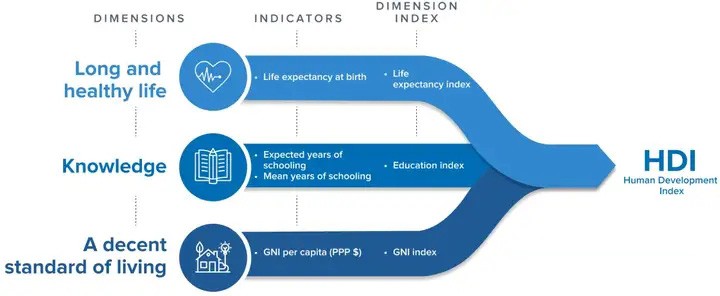
First, before discussing the Human Development Index (HDI) and its rankings, one must at least clarify the definition and calculation method of the HDI. The HDI comprises three components: life expectancy, education (mean years of schooling and expected years of schooling), and gross national income per capita. It is designed to measure key dimensions of human development: a long and healthy life, access to knowledge, and a decent standard of living.
02.webp.jpg

The calculation methods for each component are as follows:
04.jpg

Thus, given such a standardized index, I personally see no trace of any sinister “Germanic lizard-people caste-based win-theory” embedded within it. Of course, if certain “barbarology scholars” insist the index is biased, they are welcome to run their own econometric analyses—by all means, go ahead.
05.webp.jpg

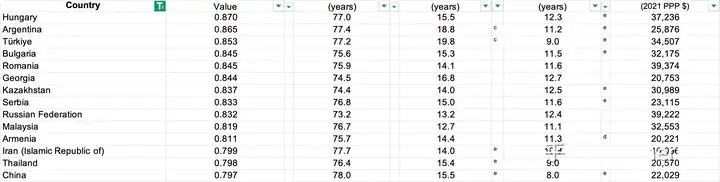
Now, let’s examine the countries mentioned in the question. Life expectancy is roughly similar across these nations, so its impact on rankings is negligible. As for former Warsaw Pact countries in Eastern Europe—such as Romania, Russia, and Hungary—their GNI per capita adjusted by purchasing power parity (PPP) (note: some answers mistakenly use nominal GDP per capita; please get the concepts right) is over 50% higher than that of mainland China. I don’t think this is particularly controversial. Meanwhile, countries like Armenia, Georgia, and Serbia, whose per capita income is roughly on par with China’s, benefit from an “education bonus” in the HDI—likely a legacy of the Soviet or Yugoslav education systems. Iran exemplifies this even more clearly: aside from mean years of schooling (MYS), none of its other indicators surpass those of China.

Specifically, MYS refers to the average number of years of education actually received by people aged 25 and older, based on the overall population’s educational attainment. For example, if every citizen in a country completed 15 years of education before age 25, that country’s MYS would be 15.0—not 1.0 as incorrectly stated in the original text (this appears to be a misunderstanding; MYS is measured in actual years, not normalized to 1.0). In China’s case, the relatively low MYS reflects the fact that older generations received far less education—a consequence, arguably, of the suspension of the national college entrance exam (Gaokao) during certain historical periods.

Of course, one could also argue that the “diploma mills” of the former Eastern Bloc produced worthless degrees, and thus propose excluding education entirely from the HDI—considering only life expectancy and income. Under such a revised metric, mainland China (0.852) would surpass Georgia (0.822), Iran (0.825), Armenia (0.829), Thailand (0.836), and Serbia (0.847).

Finally, let’s address Thailand—a country frequently cited in other answers. I believe Thailand is the least controversial example here. It’s right next door, offers visa-free entry to Chinese citizens, and one can easily fly over for a visit and enjoy some durian. Thailand’s HDI is only 0.001 higher than China’s—well within the margin of calculation error. If we were to treat Thailand as a Chinese province, its development level would comfortably sit among China’s mid-tier provinces. A difference of merely 0.001 is entirely plausible and not at all unreasonable. Ask yourselves honestly: are Nanning in Guangxi or Kunming in Yunnan really significantly more developed than Bangkok?

山园小梅    发表于  前天 14:16 | 显示全部楼层
Iran has implemented numerous public welfare reforms in the past two or three years, significantly boosting its scores on many livelihood-related indicators—though this hasn’t been widely reported. The same applies to Vietnam, Indonesia, and Malaysia.

According to the latest ranking in this report, the top 10 countries/regions are:

Iceland, Norway, Switzerland, Denmark, Germany, Sweden, Australia, Hong Kong (China), Netherlands, and Belgium.

Hong Kong (China) and the Netherlands share the same HDI score of 0.955, tying for 8th place. China ranks 78th—not particularly poor—but some respondents reacted strongly because China is ranked behind Thailand and Iran.

Thailand’s higher score is primarily due to its higher "mean years of schooling" among adults.

In 2023, China’s life expectancy at birth was 78.0 years; expected years of schooling for children was 15.5 years; mean years of schooling for adults was 8 years; and GNI per capita (PPP) was USD 22,029.

Thailand’s figures: life expectancy at birth 76.4 years; expected years of schooling 15.4 years; mean years of schooling 9 years; GNI per capita (PPP) USD 20,570.

These numbers align closely with the actual distribution of educational attainment across China’s population:

In fact, the greatest value of China’s education system lies in its provision of basic education—primary plus junior secondary school—which (1) addresses fundamental literacy needs and reduces illiteracy, and (2) supports urbanization by transforming this population into a large pool of low-cost labor, channeled toward industrial hubs.

Moreover, China has a vast elderly population with only primary school education, which significantly drags down the national average years of schooling.

This UN-published Human Development Index is also a key component of the “developed country” criteria, specifically designed to prevent nations from artificially inflating GDP through resource extraction or capital-intensive inputs alone and thereby falsely qualifying as “developed.”

The report categorizes 193 countries and regions into four tiers:

Rank 1–74: Very high human development (HDI ≥ 0.800)

Rank 75–124: High human development (HDI 0.799–0.700)

Rank 125–167: Medium human development (HDI 0.699–0.550)

Rank 168–193: Low human development (HDI < 0.550)

In reality, our personal lived experiences—regarding wages, labor protections, freedom of expression, public welfare, and other aspects—often do not align with what a “high HDI” supposedly indicates.

Many international macro-level rankings suffer from methodological peculiarities, and the domestic per capita data they rely on have long been distorted. Too often, we are simply “represented without consent.”
熙龙    发表于  前天 14:18 | 显示全部楼层
People who believe this stuff really have their whole lives figured out.

Here are a few examples:

1. In the "World's Safest Cities" rankings, several U.S. cities like Los Angeles appear in the top ten—yet not a single Chinese city makes the list.

2. Before the pandemic, authoritative institutions ranked China’s disease control and response capabilities in the lower half globally, placing the U.S. among the top three—claiming China lagged behind even many Southeast Asian countries.

3. Right before the First Sino-Japanese War, Western nations rated the Qing Dynasty’s navy as the strongest in Asia (the Qing fleet, like modern-day India, was a hodgepodge of foreign-made equipment).

4. In the 2024 authoritative global air force ranking, China is placed seventh and India sixth—the justification being that although China has more fighter jets than India, their quality is supposedly inferior.

And those are just official rankings. If you browse Western social media like TikTok or YouTube, in combat aircraft power rankings, China’s most advanced J-20 is typically placed eighth or ninth, while the J-35 doesn’t even exist in their databases.

No matter what kind of advanced technology or weaponry China unveils, the top-voted comments always include something like: “Looks impressive—but it’s made in China” (perpetuating the century-old stereotype that “Made in China = junk”).

So the truth is: quietly focusing on development is what really matters. When others praise or deliberately smear you, just smile and move on.
马建涛的歌迷    发表于  前天 14:19 | 显示全部楼层
As for the question, in brief:

1. The three HDI components should not be treated as equally weighted. The education index cannot carry the same weight as income and life expectancy.

2. The World Bank or IMF recognizes that currencies in developing countries are generally undervalued relative to those of developed nations in PPP terms—but fails to acknowledge that China’s purchasing power is also significantly underestimated compared to other developing countries. This leads to the puzzling result that many developing countries report PPP-adjusted per capita incomes mysteriously higher than China’s.

According to World Bank statistics, China’s nominal GDP per capita in 2023 was USD 12,614—slightly below the global average of USD 13,170—ranking 88th among 216 economies. The IMF reported a nearly identical figure of USD 12,597, placing China 73rd out of 196 economies.

Using purchasing power parity (PPP), China’s GNI per capita was 24,360 international dollars (World Bank) in 2023, ranking 79th globally. The IMF’s PPP-adjusted GDP per capita was 24,503 international dollars—also 79th.

Thus, even under PPP adjustment, China’s ranking remains largely unchanged from the nominal exchange rate-based ranking.

The reason lies in the World Bank’s International Comparison Program (ICP), which assigned China a total consumption price index of 98.56 in 2021 (world average = 100), implying that China’s price level is roughly on par with the global average. With such a baseline, it’s no surprise that PPP-adjusted rankings shift little.

However, we also note that under the same ICP framework, China’s Taiwan Province has a consumption price index of only 81.46—meaning its prices are reportedly 20% lower than mainland China’s. Hong Kong’s index is 123.88, and Singapore’s is 114.02… These figures clearly deviate significantly from observable reality, inevitably raising doubts about the scientific rigor of the ICP’s sampling methodology.
之秋    发表于  前天 14:20 | 显示全部楼层
Although China’s economy is the second largest in the world, when it comes to individuals—everyone I know or have contact with, from business owners, venture capitalists, partners, and senior government officials, down to my colleagues, fresh university graduates, interns, outsourced staff, bank tellers, food delivery riders, middle school teachers, bank branch managers, and marketing directors—not a single person can confidently say they feel happy, joyful, or content living in China.

This clearly reflects a real issue: national strength and prosperity do not necessarily translate into individual happiness—in fact, the two may even be inversely related.
12
您需要登录后才可以回帖 登录 | 立即注册

Archiver|手机版| 关于我们

Copyright © 2001-2025, 公路边.    Powered by 公路边 |网站地图

GMT+8, 2025-12-24 00:04 , Processed in 0.167995 second(s), 29 queries .